- Introduction
- Chapter I: My Family and My Town
- Chapter II: Deportation
- Chapter III: Amnesty
- Chapter IV: The Journey to Kazakhstan
- Chapter V: In Dzhambul
- Chapter VI: In Iran
- Epilogue
Chapter I
My Family and My Town
Wołkowysk, 1928–1940
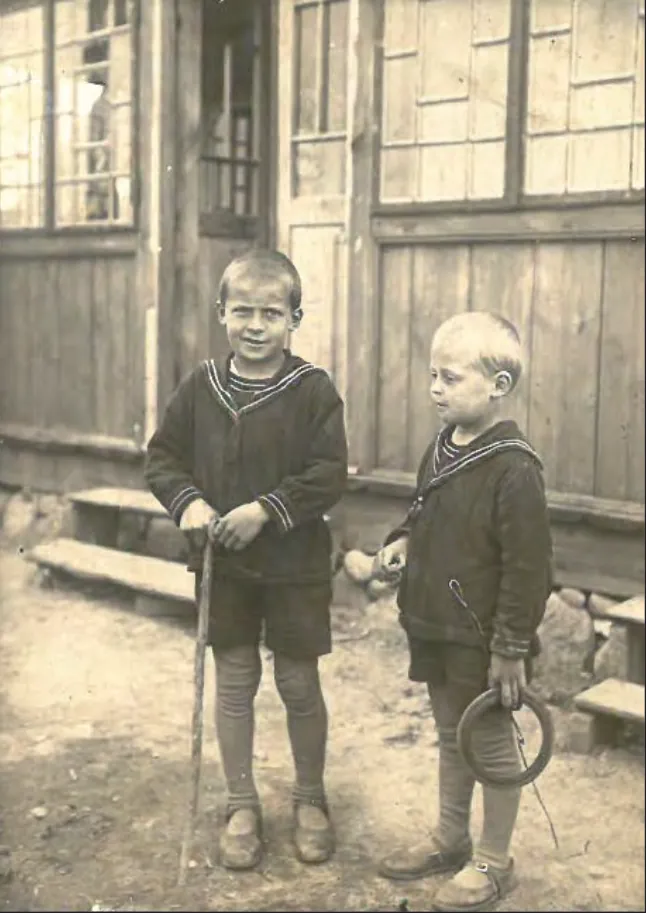
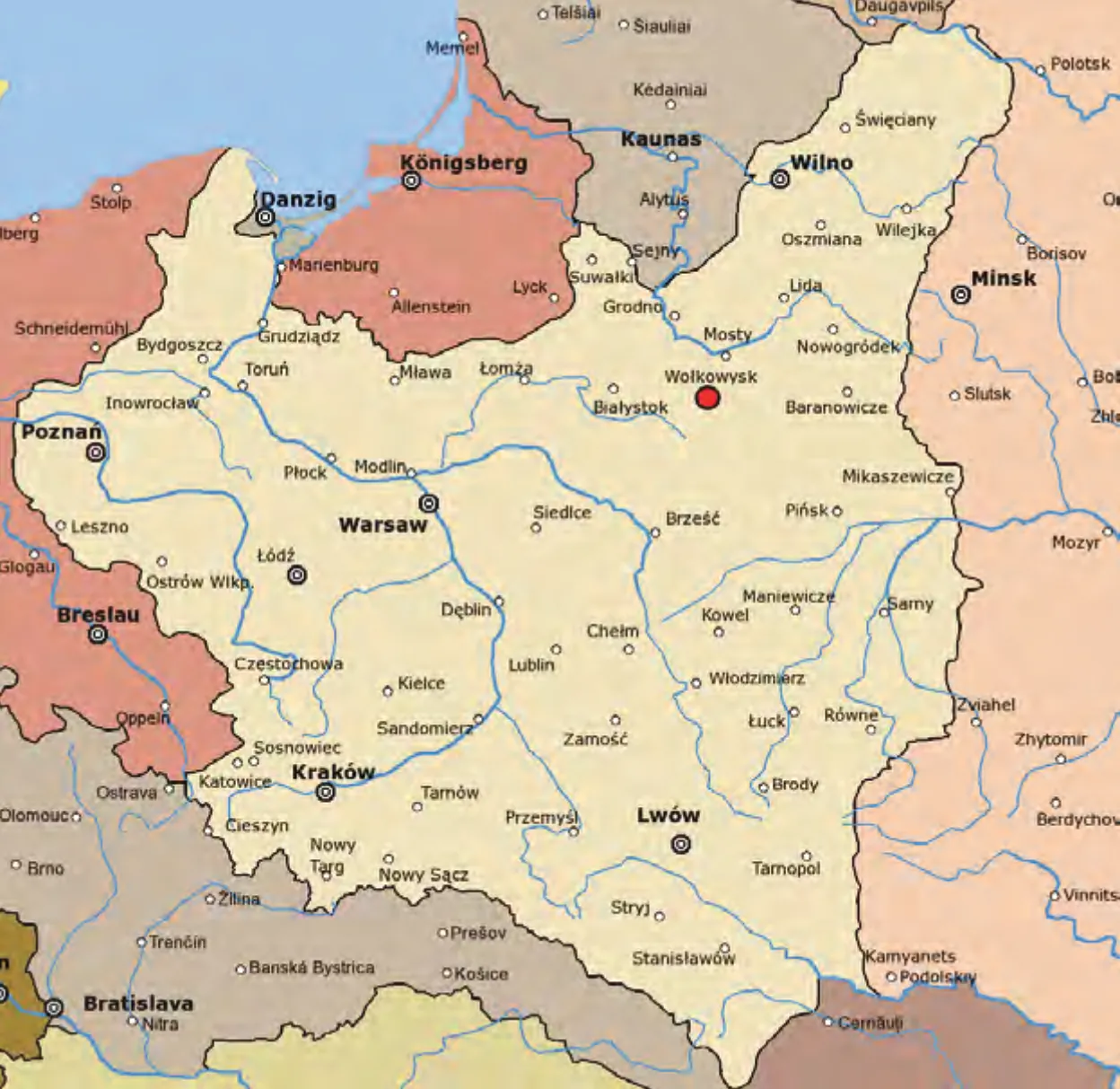
I was born in 1928 in Klonów, in the Kielce district, where my Father worked as a forester for the State Forests. From 1930 to 1934 we lived in eastern Poland, in the Kosów Poleski district, where Father had been appointed district forester. In 1935 Father was transferred to Białowieża, where he worked at the State Forests Directorate, and towards the end of 1936 we moved to Wołkowysk in the Białystok Voivodeship, where Father was given the post of forester. There were five of us in the family. Mother was a teacher by profession, but from 1930 she no longer worked, as she devoted herself to bringing up three children. I had a brother, Zbyszek, a year and a half older than me, and a sister, Hania, six years younger. I started the first year of primary school in 1935 in Białowieża, and from 1936 to 1939 I continued in the second, third and fourth years in Wołkowysk.
Speaking of the family, I would like to give a few details of my Father's life. His biography contains a fine record of the struggle for independence. In June 1915, at the age of 22, he volunteered for the First Brigade of the Polish Legions commanded by Józef Piłsudski and was assigned to the 1st Infantry Regiment. The First Brigade fought on the Austro-Hungarian side against Russia. In August 1915 Stanisław Bachmiński was wounded in the battle of Wysokie Litewskie. A rifle bullet passed through both his legs and he ended up in hospital. After his wounds had healed and he had recovered, he returned in November 1915 to his regiment, which was fighting in Volhynia. The First Brigade was then taking part in a successful offensive against Russia and reached the Styr, a southern tributary of the Pripyat, where it fought heavy battles with the Russians. Father fought on the Styr and the Stokhid until August 1916, enduring great hardship in the trenches, often under heavy artillery fire, as a result of which he suffered concussion. Father served in the First Brigade for 25 months, until the Oath Crisis of July 1917. The Oath Crisis arose because the Polish Legions were to be placed under German command and the legionaries were required to swear an oath to the German Emperor. Like most soldiers of the First Brigade, Father refused to take the oath and was consequently to be interned. As he told it, while being transported to Szczypiorno (a village near Kalisz), he and a comrade jumped from the moving train and so escaped internment. After this escape he went to Lwów in the hope of continuing his studies at the College of Forestry. Between 1917 and 1919 he studied with interruptions, living in lodgings and earning his keep by giving private lessons. The College of Forestry was an independent school, and in 1919 it became one of the faculties of the Lwów Polytechnic.
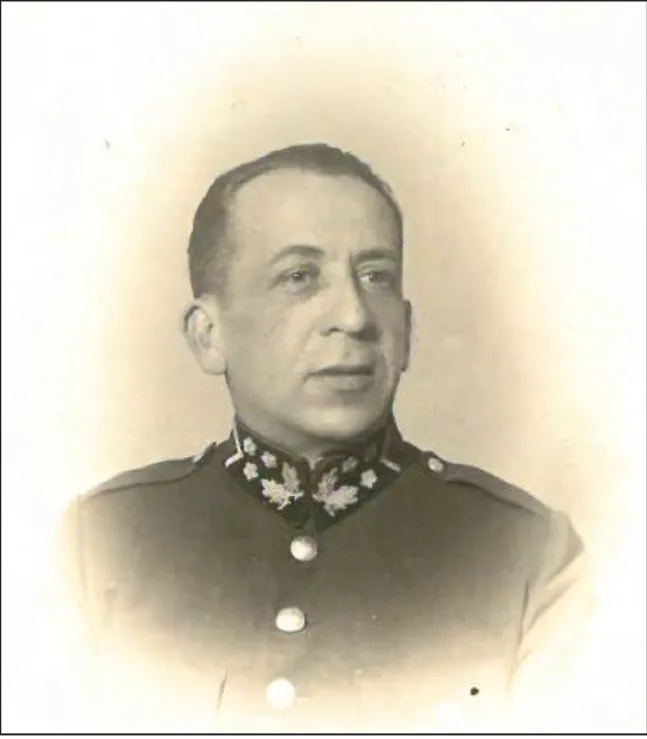
In November 1918 Polish–Ukrainian fighting broke out over Lwów. Soldiers of Ukrainian nationality serving in the Austro-Hungarian army, seeing that the war was coming to an end, seized a number of key points in Lwów on 1 November 1918 and took over the administration, intending to make the city part of the newly forming West Ukrainian People's Republic. In the district where Stanisław Bachmiński lived, Ukrainian units carried out an operation against the young Poles living there, aiming to eliminate them, since most were trained soldiers who could reinforce the Polish units defending Lwów. According to Father's account, the Ukrainians searched his home and then led him out to a square where a group of Poles had been gathered, probably to be shot. Fortunately a Polish aircraft appeared and fired on the Ukrainian soldiers assembled in the square, and everyone scattered. Taking advantage of the confusion, Father escaped from the square and hid in a cemetery, where he stayed for several days until Polish units drove the Ukrainians out of that district. The fighting for Lwów lasted until 22 November 1918 and ended with the Ukrainians being driven out of the city, but until May 1919 Lwów remained encircled and shelled by units of the Ukrainian Galician Army. In April 1919 Father returned to military service in Lwów, serving for five months as a corporal in a Polish Army guard battalion. After completing his studies he began work in 1920 as a forester for the State Forests in the Kielce Voivodeship. In 1933 Stanisław Bachmiński was awarded the Cross of Independence by the President of the Republic. I should add that Father's two younger brothers, Wacław and Józef, also fought in the First Brigade of the Legions. Józef went on to serve in the Polish army after independence and was badly injured in the fighting against the Ukrainians near Lwów, losing an eye in battle. As a war invalid he received support from the State: an allotment of land and a post at the Corps Command in Grodno.
I would also like to mention my great-uncle, Stanisław Bachmiński, who took part in the January Uprising. He was a student at the Main School in Warsaw and when the uprising broke out he joined the insurgent unit “Children of Warsaw”, in which he held the command of a sotnik (company commander). He was killed on 14 April 1863, aged 21, in a clash with the Russians at Buda Zaborowska in the Kampinos Forest. In all, 73 insurgents died there, including Major Remiszewski, the unit's commander. There is a mass grave of the insurgents who fell in that battle at Zaborów Leśny.
We lived in Wołkowysk from 1936, and I would like to say something about the town and about events of that time which have stayed in my memory to this day. It was a county town with about 17,000 inhabitants in 1939. The town had a Public General (primary) School, a State Gymnasium and Lyceum, a private four-year Commercial Gymnasium, and also a private primary school known as Mrs Pawęska's School. Pupils of all the schools wore peaked caps of different colours and shapes, from which one could tell which school they attended. I should add that fees were paid at the State Gymnasium and Lyceum, although the children of civil servants received a 50 per cent discount. Near the town centre there was a Roman Catholic church and an Orthodox church. We had a football team, Strzelec, which must have been quite good, because I remember being at a match when Strzelec beat the Jewish team Makabi 12:0. The Staniewski Circus and the Popular Circus came to town, and I never missed a chance to see their performances. There was also a cinema. The Reduta Theatre came to us from Warsaw, and my parents always made a point of attending its performances. Wołkowysk was a railway junction with two stations, Wołkowysk Miasto and Wołkowysk Centralny, and a halt, Wołkowysk Przedmieście. Remarkably, twice a week an international train ran along this line eastwards towards the USSR and back, from Calais via Paris, Berlin and Warsaw to the border station of Stołpce–Negoreloye. At Negoreloye passengers changed to a broad-gauge train and went on to Moscow. The return journey followed the same route westwards. The train made a great impression on me as it sped past, its wheels clattering loudly on the rails along a line running close to my school, before curving away along the edge of the forest towards the eastern border.
The Third of May holiday was celebrated with ceremony in Wołkowysk. The 3rd Mounted Rifles Regiment held a parade, and veterans of the struggle for independence, in their best clothes and wearing their military decorations, went with many of the townspeople to watch it. I remember well one such parade in 1938, which I attended with Father. Wołkowysk is a town with a long history connected with important events. In 1386 the Grand Duke of Lithuania, Jogaila, stopped in Wołkowysk, where he met a Polish delegation from Kraków, and together they confirmed the terms agreed at Krewo for Jogaila's accession to the Polish throne and his marriage to Jadwiga, who then occupied it. Wołkowysk, part of the Grand Duchy of Lithuania, was captured and burnt by the Teutonic Knights in 1410. A reminder of the Polish–Swedish war known as the Deluge, in which the town suffered, is the name Swedish Hill given to Castle Hill, because the Swedes built a redoubt on that height and defended themselves there against the Poles. Swedish Hill is the highest point and a viewpoint on the edge of the town. During Napoleon's march on Moscow in 1812 the town burnt down. After Poland regained independence, the barracks built in tsarist times were taken over in 1922 by the 3rd Mounted Rifles Regiment.
Like most towns in the east of the Poland of that time, Wołkowysk had a large Jewish population. In 1939, 6,900 Jews lived in the town, 40 per cent of its population. In my class there was only one girl of the Jewish faith, with a Polish surname, Zelwiańska. Nobody discriminated against her; during the morning prayer that we said at the start of the first lesson she stood up with the rest of the class, but did not take part in the prayer. The Jews had several Talmudic schools of their own in the town, so there were few of them in the public school. As I remember it, there was no conspicuous antisemitism in the town. The Jews dominated trade, as in most towns in eastern Poland. However, when Polish shops began to open, their owners often displayed the slogan: “Don't buy from Jews.” Poles did not avoid buying in Jewish shops, all the more so because they could buy there on credit. I once saw a well-dressed Polish woman, probably an official's wife, walk into a Jewish grocery, pick out a good many goods from the shelves, and instead of paying in cash hand the shopkeeper a notebook in which he wrote down the goods sold on credit.
In Wołkowysk we first lived for a year in a large two-storey house at 5 Zastawa Street, where we occupied the ground floor, while the owner, Mr Gołgowski, lived upstairs with his wife and three sons. The owner's boys, the same age as my brother and me, were very sporty, and we practised various events with them in the yard, such as the long jump, the high jump and the pole vault. A hundred metres from our house flowed the little river Wołkowyja, and in the hot summer of 1937, during the holidays, we ran across the meadow many times to bathe in it. That was when I learnt to swim, and the following year I improved by swimming in the reservoir formed by a dam on the Wołkowyja and in the town swimming pool. On Mr Gołgowski's property there was a pond which, when it froze in winter, was a good place for us to skate close to home. In the autumn of 1937 we moved to a newly built house at 40 Wileńska Street, owned by Mr Zaleski, a sworn surveyor. It was a single-storey brick house for two families; the owner occupied one half and we took the other, equal half. We had three rooms and a kitchen; water was drawn from a well, and there was an outdoor privy in the yard. The rent for this flat, as for the previous one, was paid by the State Forests Directorate. Our house was the last but one on Wileńska Street; beyond it fields stretched as far as the Castle Forest, two kilometres away. The Castle Forest was under Father's supervision as forester, and he usually cycled along the gravel road to inspect the forestry work.
Our close neighbour was Mr Gabrowski, who ran a shoemaker's workshop; I was in the same class as his son Władek and shared a two-seat desk with him. A neighbour a little further off was Mr Ciepłowski, a friend of Father's, with whom Father corresponded in 1940–1941 when we were in the Arkhangelsk Oblast. Beyond Mr Ciepłowski's house there was a large sand pit, and I mention it because in winter I learnt to ski on its slope. From Wileńska Street to school was about a kilometre and a half, which I walked, usually with my neighbour and friend Władek Gabrowski. As a curiosity I might add that one of my classmates, the son of a district forester, rode to school on a pony from somewhere outside Wołkowysk. He had to, because there was no bus service in the area. When the war broke out on 1 September 1939, Wołkowysk was far from the front, but we lived through the war intensely, because the radio broadcast news of the Polish army's retreat and, most often, constantly repeated warnings of yet another air raid on Warsaw: “Attention, attention, eR-A koma 3 is approaching,” or: “Attention, attention, RA-DA has passed.” These coded messages were surely understood by the people of Warsaw, although we too knew that they meant Warsaw was about to be bombed again, or that a raid was over. Wołkowysk was bombed once, near the railway station, but the bombs hit neither the tracks nor the station building, though the three bombs dropped left deep craters right beside the tracks, a few dozen metres from the station, and blew out the windows in nearby houses. I went there and saw the damage. From then on many townspeople began taping narrow strips of paper across their window panes, believing that the strips would stop the glass from shattering during a bombing. I do not know whether the taping made any sense, but there were no more bombings, so its effectiveness could not be tested. On one occasion a German bomber dropped its bombs on a field near the Castle Forest, and I ran there with Zbyszek and a whole crowd of people to look at the craters left by three bombs. People picked up the sharp pieces of metal that had filled the bombs. It was clear that the pilot had got rid of his bombs so as to return to base without a load. I also remember a Polish fighter plane landing in a field near the forest, probably with engine trouble. Again we all ran to see what had happened. These were the sounds of war that reached Wołkowysk. News also came that the plywood factory in Mosty, 25 kilometres from Wołkowysk, had been bombed. I had visited that factory in 1938 while at a scout camp on the Niemen near the town, so the news of the bombing upset me greatly. Plywood was used in building aircraft, which is why the Germans targeted the factory in Mosty.
September 1939 was fine and cloudless, and German aircraft appeared quite often in the sky, flying very high, at about 8,000 metres, but they posed no threat to us. Soon anti-aircraft artillery arrived in our area to defend the town. Two anti-aircraft guns were emplaced and dug in right behind the fence of our garden at 40 Wileńska Street. But those guns never once fired at the German planes, probably because the planes were flying too high and did not intend to bomb the town, having some more distant target. Our guns held test firings several times, which we could watch from close by. Foreseeing that the front might reach Wołkowysk, and fearing air raids too, Father began digging an air-raid shelter in the garden, and my brother and I helped him. The shelter was a rectangular trench a metre and a half deep, covered with boards and a layer of earth. At the entrance there were steps reinforced with boards for going down and climbing out. The front was still far away, although it was approaching fast. One day I saw a cavalryman appear in town on horseback, evidently wounded, for his head was bandaged; a crowd gathered around him and the soldier announced that the Poles were winning and that General Bortnowski had taken Pomerania. Today one can say that this news, though it raised our spirits, had nothing to do with the real situation at the front.
We lived quite comfortably in our three-room flat, but the comfortable life ended around the middle of September 1939, when a large family arrived at our house, having fled to Wołkowysk ahead of the advancing front. It was a district forester from central Poland with his wife, his wife's sister and two grown-up sons, twins who had already passed their school-leaving exams, Tadzik and Zbyszek. On reaching Wołkowysk they decided to go no further, and the district forester asked my Father to take them in. Father did not know him, but following the principle that a forester is duty-bound to help a forester, he let him and his family live with us. They stayed with us for about a month. Only in the middle of October did they leave Wołkowysk and cross the “green border” into the German-occupied zone. My Father's decision to take a fellow forester under his roof was, in my opinion, a praiseworthy act, considering that our guests not only lived and slept in our home (there were ten of us altogether in a three-room flat) but also had to be fed. Food supplies had become much worse, especially after the Soviet troops arrived. Polish currency went out of circulation and our guests had no roubles, though I do not rule out that they may have sold valuables. But things cannot have been all that bad yet, because I remember Tadzik and Zbyszek urging my Mother, who was cooking dinner, to make the broth with two chickens rather than one, as she had suggested. I remember Tadzik and Zbyszek as likeable people. Zbyszek had a good voice and often sang popular songs, most often “Marianna, Marianna, ta cudna panna” (Marianna, that lovely girl). Tadzik tried to be a good friend to me, an eleven-year-old, but our friendship ended when he told Father that I was smoking cigarettes.
The German armies advanced relentlessly.
We knew that Warsaw was besieged and holding out, while things were fairly quiet where we were, though everyone knew that total defeat was near, when unexpectedly, on 19 September, units of the Soviet army appeared in Wołkowysk. Long columns of infantry marched along the highway from the north-east, from the direction of the Castle Forest, and on down our Wileńska Street towards the town centre. Between the infantry units one could see guns towed by tractors. The troops marched along the street past our house, which stood a dozen or so metres back from the road. One Red Army soldier, walking barefoot and carrying on his shoulder the boots that had rubbed his feet raw, came in through our gate and asked for the well, because he wanted a drink of water. Soon a long column of tanks arrived. When the tanks entered the town they badly damaged the streets, tearing up the cobbles, especially on the corners, which were made of round fieldstones known as “cats' heads”. That day and on the days that followed, huge four-engined Soviet aircraft appeared overhead with a characteristic powerful drone. At home my parents and our refugee guests discussed Poland's lost war and wondered what hope there was of undoing what had happened. A rhymed prophecy appeared in the town, copied out by hand and passed from hand to hand, which gave hope that Poland would regain its independence. To this day I remember fragments of this prophecy, which I learnt by heart at the time. I shall quote some of them here.
Two decades on, those times shall come to pass,
When fire shall burst down from the sky,
Then Wernyhora's songs shall be fulfilled,
The whole world shall choke on blood.
Poland shall rise from the world's great blaze,
Two eagles shall fall, shattered,
Yet long her fate shall still be dark,
Her dreams still unfulfilled.
The defiled cross shall fall together with the hammer,
Nothing shall remain to the partitioners,
Masurian land shall come to Poland again,
And at Gdańsk our port shall rise.
People tried to interpret the words of the prophecy in various ways, but generally optimistically. The words lifted people's spirits, because they held out hope that all would end well.
After the Soviet troops arrived, the town began to adapt to the new authorities. At the beginning of October my primary school reopened. I started the fifth year by the Polish reckoning, although officially it was called the fourth year, to fit our twelve-year course of primary and secondary education to the Soviet ten-year school system. My form teacher, who taught most subjects, was Mrs Wiktoria Rogowska, the same teacher who had taught us in the lower years. Belarusian was introduced as an additional subject, and since the school had no specialist in the language, Mrs Wiktoria was obliged to teach it. As she did not know Belarusian herself, she had to prepare hard for the lessons. Unfortunately it went very badly, and one could see how she struggled reading to us from a Belarusian textbook. I remember that one day Mrs Wiktoria came into class in tears, red-eyed and unable to teach. She told us that her husband, who worked at the county office as a school inspector, had been arrested by the Soviet authorities. My Father was summoned to the town hall, where the new Soviet administration now sat, and was told that he was to carry on as forester and would work for the Leskhoz, the body managing forestry. Soon a Russian, the head of the Leskhoz, arrived and Father began working with him. Father received a salary of 600 roubles a month, and the rent for our flat was also to be paid by the Leskhoz, which had taken over the functions of the former State Forests Directorate.
In the first days after the Soviet troops entered the town, some Jews welcomed the invaders with great enthusiasm. In the town centre I saw a small group of Jews marching with a red flag, laughing and singing the war song “Esli zavtra voyna” (If War Comes Tomorrow). The satisfaction visible on their faces may have shown that they expected great benefits from Soviet rule. It cannot be ruled out, however, that they had previously suffered discrimination from Poles and were therefore happy and hopeful that Soviet rule would give them equal rights. But it seems they miscalculated, for in the third deportation of Polish citizens, of the so-called bezhentsy (refugees), which took place on 29 June 1940, the Soviets deported about 79,000 people from the Polish territories annexed to the USSR, of whom about 71,000, over 90 per cent, were Jews. The bezhentsy were people from western and central Poland who had fled the advancing German army and found themselves after 17 September 1939 in territory occupied by the USSR. The deportation of some 71,000 Jews clearly shows that the Soviets did not treat Polish Jews as privileged but, without any scruple, condemned them to extermination just as they did the Poles.
Life in the town grew much worse because of food shortages. One had to stand in long queues for salt and sugar. I stood in such queues myself several times. In the town centre one saw many Soviet soldiers, mostly officers. The barracks left by the 3rd Mounted Rifles Regiment were probably now occupied by a larger Red Army unit. At the beginning of September 1939 the 3rd Mounted Rifles Regiment had left its barracks to join Operational Group “Narew”. The regiment received its baptism of fire on 9 September and then fought until 5 October, taking part in many clashes with the Germans.
One day, towards the end of October, a lady came to see us, bringing a pedigree dog and asking my parents to look after it, because she had several dogs and could not feed them. I do not know who gave her our address, but evidently Father was known in the town and someone had recommended him. She and her sister had fled before the approaching front. The ladies reached Wołkowysk and there was nowhere further to flee. They had fled together with ten pedigree dogs. Here in Wołkowysk they rented a flat, but the pack was too large to feed, so they began giving the dogs away to good homes that had been recommended to them. We took in a white spitz called Laluś, and he stayed with us for a couple of months without causing much trouble, except that he was an aristocratic dog: he occupied the armchair and would not eat just anything, while good food was becoming ever harder to find. Once his owner came to visit her pet and fed him sausage, but in our house he could not count on such delicacies every day. In the end my parents decided that the dog had to be returned to his owner. I was given the task of walking Laluś on his lead to her lodgings. When I reached the address, I saw how the refugee ladies lived. It was a single room, which the two ladies shared with several dogs. There was a very strong smell of dog in the room. Laluś was happy to be back among his own. I do not know how long those ladies managed to survive with their pack of dogs under Soviet rule.