- Introduction
- Chapter I: My Family and My Town
- Chapter II: Deportation
- Chapter III: Amnesty
- Chapter IV: The Journey to Kazakhstan
- Chapter V: In Dzhambul
- Chapter VI: In Iran
- Epilogue
Chapter IV
The Journey to Kazakhstan
From Glazanikha to a kolkhoz near Dzhambul, 1941
We left Glazanikha as soon as loading was finished. Winter had not yet come, but on the day we left the first snow began to fall. We headed south-east and via Kodino reached Obozersky, and from there on the Arkhangelsk–Moscow line we reached Vologda, a large junction. From Vologda we went east towards the Ural Mountains, and after many days of travel we reached Sverdlovsk (Yekaterinburg), a large city beyond the Urals, and from there Chelyabinsk. Our goods train ran outside any timetable, often standing for a long time in sidings to let other, more important transports pass. This line was far from the front, German aircraft did not reach it, so there were no air raids and we travelled quite safely. At that time the Soviet authorities were evacuating many factories beyond the Urals from areas threatened by German occupation, and much of that evacuation went along the very line on which we were now travelling.
The journey was uncertain all the time. One never knew when the train would stop or start again, which made it hard to buy food, and there was also the fear of not getting back on board before the train left. The representatives of our group of amnestied Poles travelling to Uralsk had a certificate entitling us to a bread ration at the larger stations. I remember that the first bread we managed to buy collectively for the whole transport was only after two weeks of travel, in Sverdlovsk (Yekaterinburg), where we had a longer stop. Everyone fell on that bread, and they must have been very hungry, because one could see almost everyone choking on it, eating too fast. I remember the next large station, Chelyabinsk, well, because my brother and I went into the city centre. There were wide streets and apartment blocks several storeys high, but there was nothing in the shops. We did, however, manage to buy something of great trading value: matches, of which we bought several dozen boxes. Later in the journey matches were a valuable item of barter. Some of our Poles bought live animals during the journey, such as calves or sheep, and slaughtered them on the siding where the train stood, dressed the carcasses, and so had a good meal. But these were people who had been farmers and stockbreeders before the deportation and could now use their skills in slaughtering. At every station of any size there was a tap marked kipyatok, boiling water, where everyone could draw hot water free of charge. Thanks to our stores of flour and groats we did not go hungry on the journey, but it was hard to buy eggs, butter, meat, potatoes or vegetables where the train stopped. A few bottles of oil obtained before we left helped a little, but not for long.
Nobody noticed when, bypassing Uralsk, the supposed destination of our journey, we found ourselves in Kazakhstan, and heading south-east we approached the Aral Sea, and then, travelling further south, we found ourselves in Uzbekistan and reached Tashkent, the capital of that republic. It was already November, but it was quite warm here. At small stations the locals sold fruit and vegetables and even raisins, kishmish. It was a region with a warm climate, where grapes, watermelons and cotton were grown.
From Tashkent our train turned south-west and we reached Samarkand, a large city with many oriental monuments and a long history going back to antiquity. At that time none of us was interested in sightseeing, and when the train stopped at the goods station in Samarkand, our people scattered towards the town to buy something. My brother Zbyszek and I also ran towards the railway station to buy something to eat. We managed to do our shopping, but when we came back to where our train had been standing, the train was gone. We searched the whole station, but it was not there, and a railwayman told us that a goods train carrying people had left for Bukhara. We decided to catch up with it by taking the first passenger train to Bukhara, without a ticket, of course. Evening was approaching and it was getting cold, and we had no warm clothes on and faced a night journey. But our greatest worry was whether we would be able to find the train at all, since it had no distinguishing marks and no fixed destination. Soon a passenger train bound for Bukhara pulled into the station. We got into one of the carriages, but before the train moved off, a conductor appeared and roughly threw us out, shutting the door. We stayed outside, working out what to do next. When the train started, we jumped onto the carriage steps and settled ourselves there. And so our night journey began. It became very cold (it must be remembered that it was already the last ten days of November) and the wind froze us even more as we travelled. The train seldom stopped, as it was an express, but when it stopped at larger stations we jumped off the steps so as not to fall into the conductor's hands, and when the train moved off we were back on the steps again. After three hundred kilometres we reached Bukhara at dawn. Unfortunately our train was not there. Luckily, after a few hours we managed to find it at the goods station: evidently it had travelled more slowly than our passenger train and fallen behind. It was a great stroke of luck that we found each other. Had we not, we would have been completely lost, separated from our family with no chance of ever finding them again. We did not know the name of the place our transport was heading for. At that time more than a hundred thousand Polish citizens released from special settlements and labour camps had arrived in Uzbekistan, and they were being sent to kolkhozes and factories as labour.
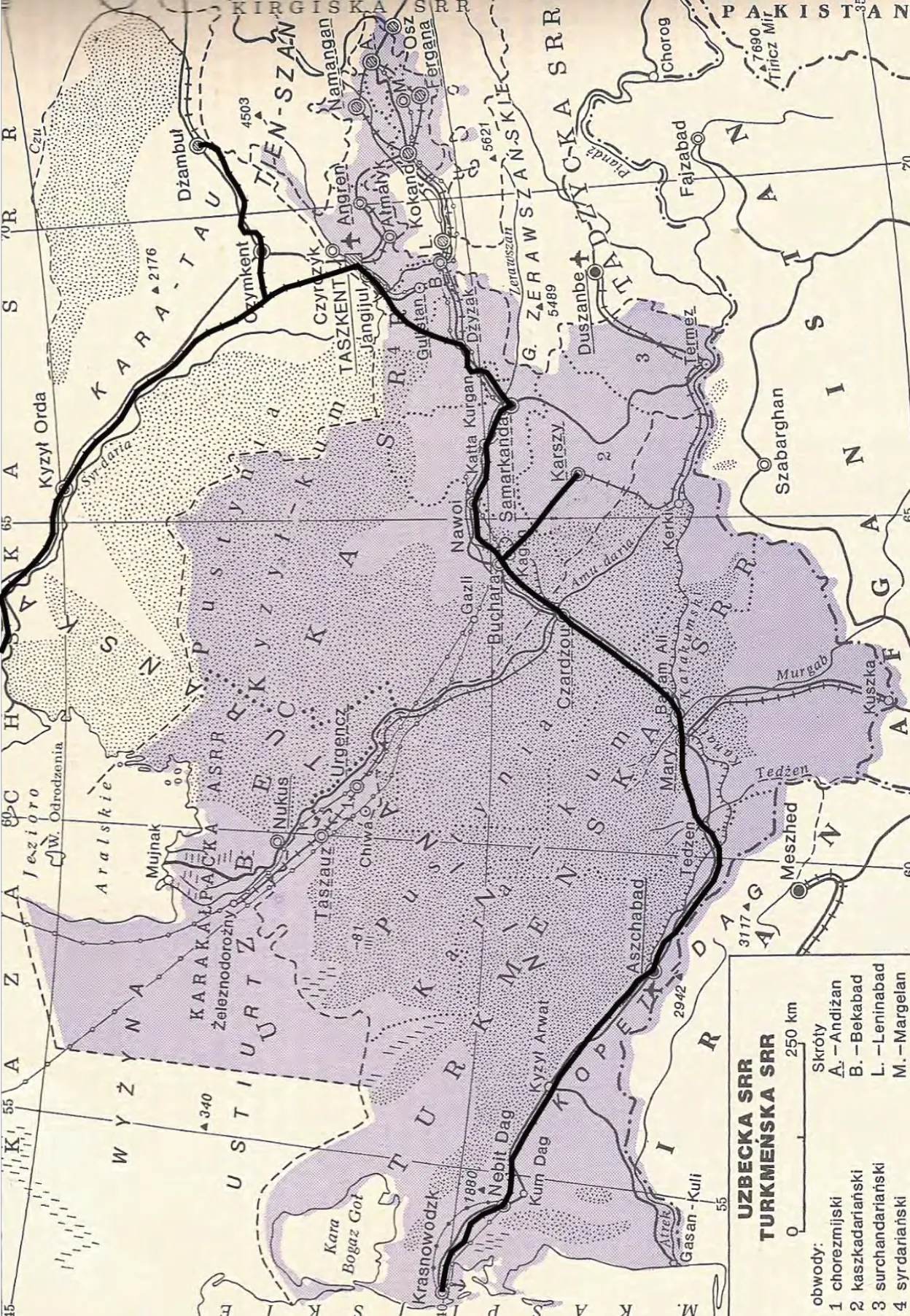
From Bukhara our transport was sent to the town of Karshi in south-eastern Uzbekistan. Here we were unloaded. All our passengers, with their bundles, were directed to a small park by the station, where we were to wait for further decisions about our destination. It was already the end of November; we had been travelling for a month and a half. In all that time we had not had a single bath, and the lice were a great torment. After a few days camping in the park, word came that there was a new eshelon at the station and we were to board it. As I later learnt, the State Defence Committee of the USSR had decided that the surplus of Poles who had arrived in Uzbekistan should be moved back to Kazakhstan. Our group, which had come in its entirety from the Onega region, was included in this transfer to Kazakhstan. We set off back the same way, through Bukhara, Samarkand and Tashkent to Arys, and from there through Shymkent eastwards towards Dzhambul. On the way individual wagons were uncoupled and the people in them were sent to kolkhozes selected to receive Poles.
Our train journey lasted three days and nights, and one night, when the train stopped for a longer time at some small station, the command came: Unload! After unloading at the small station we were put onto ladder-sided carts drawn by oxen and set off through the dark night towards some unknown destination. The Kazakh driving the cart often shouted at the oxen “tsop, tsobe”, and the oxen knew this was an order to turn right or left, like our Polish “hejta, wiśta”. After a few hours we reached a Kazakh village. It was dark night; we got down from the cart and carried our belongings into a larger room, a sort of village hall. This was the end of our journey from the White Sea to Kazakhstan. It had lasted from 13 October to 1 December, seven weeks, and in that time we had travelled six and a half thousand kilometres.
When day came, someone from the kolkhoz authorities appeared in our hall and began allocating the Polish families to Kazakh households with whom they were to live. The Kazakhs in this village lived in detached houses called kibitkas, with flat roofs, consisting of a single room and built of unfired brick. We were placed with a household living in a room with a floor of beaten clay; against the wall was a brick stove with a large cast-iron cauldron, shaped like a great bowl, set into it. Everything was cooked in this cauldron, soup and water for tea alike. There was no table or chairs in the room, only mats for sitting and sleeping. To the right of the entrance to our hosts' room there was an annexe, a sort of large windowless shed with a clay floor, presumably used to store the crops from the fields, and this shed was assigned to us as our home. It was already the beginning of December and winter was beginning to bite. We had no stove or furniture in our shed, so all we could do was lie on straw thrown on the clay floor, with no way of cooking anything. Our Kazakh landlady was very distrustful of us, but a few times she let us boil water in her great cauldron, though we had to pay for it each time with a box of matches, the matches Zbyszek and I had bought in Chelyabinsk. The stove was fuelled with so-called kizyak, cow dung dried in the sun. The kolkhoz lay on the steppe, where there were no trees, so this was the only fuel available. In the growing season the kolkhoz fields were irrigated with water distributed through aryks, ditches that brought water from a nearby river. Near the kolkhoz there was quite a high hill, which I climbed on our very first day out of curiosity to see what the surroundings looked like. Looking round, I saw that the kolkhoz lay not far from a large town. The town was Dzhambul, 11 kilometres away.
Mother knew she had to act if we were to survive the coming winter, and first of all she had to save Father, who was seriously ill. Uncured during his stay in hospital at Chekuyevo in August, he had grown steadily worse during the seven-week journey in the wagon, which he had no strength to leave when the train stopped; he just lay on the dark lower bunk. He began coughing up blood, and the swelling in his legs crept ever higher. On top of that came the extremely harsh conditions of life in the kolkhoz. Mother went to the predsedatel' (chairman) of the kolkhoz, explained her husband's state of health and declared that she must get a doctor's help. The chairman agreed to help and gave Mother an ox cart and a driver to take Father to a doctor in Dzhambul. Mother went with Father to Dzhambul and took me with her too, while Zbyszek and Hania, both with colds, stayed behind alone in the cold shed. In the town we found a clinic, where Father was immediately admitted for hospital treatment. Father was also given transport straight away, a horse-drawn cart that was to take him to the hospital. He got onto the cart, said goodbye to us, gave us the hospital's address, Soyuz Kashchi Street, and was quickly driven away. Mother and I walked back to our kolkhoz that same day. In the following days Mother set about selling the few things we still had left, as we were running short of roubles. She got a good price for a navy-blue coat, a lyceum pupil's uniform coat with red piping on the collar and sleeves, which a Kazakh woman bought for her almost grown-up daughter. All the Kazakhs present at the sale admired how beautiful the young girl with long plaits looked in the coat. It is worth mentioning that in September 1939, just before the Soviet army entered Wołkowysk, my parents, wanting to spend their złoty, which might become worthless at any moment, had bought two such navy-blue uniform coats: one for the gymnasium, with blue piping, which I wore at Katiszcze in winter, and the other for the lyceum, which had never been worn and was now sold here in the kolkhoz. Around our aul (village) stretched the steppe, the kolkhoz's farmland, but now, in December, the fields were empty. Near our hut I often came across a donkey wandering loose. One day I tried to get on it and ride it, but it ended badly for me, because the donkey bucked vigorously and threw me off its back.
The Poles who ended up in kolkhozes had no work in winter, and the kolkhoz authorities had neither the grounds nor the wish to feed them, so their lot was in practice worse than in the taiga, where there had at least been work and some minimal income. In the authorities' intentions, the amnestied Poles moved from the northern and eastern territories of the Soviet Union to Uzbekistan and Kazakhstan were to go on providing cheap labour, which was becoming scarce because of the losses at the front and the call-up of new age groups. The standard of living in the kolkhozes was very low, because productivity was low too and compulsory deliveries to the State had to be met, so the Poles who found themselves there suffered hunger and their death rate was very high. Winter set in properly in our kolkhoz: snow fell and it became very cold, and we had no stove in our mud hut. We were in a rather warm climate zone, but it was a continental climate with fairly harsh winters. Mother decided that we must visit Father in hospital, and despite the winter weather she set out for Dzhambul with me on 22 December 1941. We went on foot, and when we reached the centre we found the hospital. In the hospital office, when Mother asked which ward the patient Bachmiński was in, she was told that there was no such patient any more, as he had died on 14 December. When Mother asked where he had been buried, she was told that he had been buried in a common grave in which ten people had been laid to rest. We could not even visit the grave, because nobody could say where it was; it was somewhere outside the hospital grounds, probably in some town cemetery. We were utterly crushed by this tragic and unexpected news. There was nothing left for us but to return to our aul, where Zbyszek and Hania had stayed behind in the unheated shed without hot food, and we had to save ourselves from further misfortunes. But we did not manage to get back that day, and all night we went round various eating houses where it was warm and fed ourselves on what had been left uneaten on the plates. The next day we set off back to break the sad news to Zbyszek and Hania. Father died aged 49. His death must be laid at the door of the criminal Bolshevik system, which sought to exterminate Poles: some with a shot in the back of the head, others through a system of forced labour that destroyed their health and their lives.