- Introduction
- Chapter I: My Family and My Town
- Chapter II: Deportation
- Chapter III: Amnesty
- Chapter IV: The Journey to Kazakhstan
- Chapter V: In Dzhambul
- Chapter VI: In Iran
- Epilogue
Chapter III
Amnesty
Katiszcze, August–October 1941
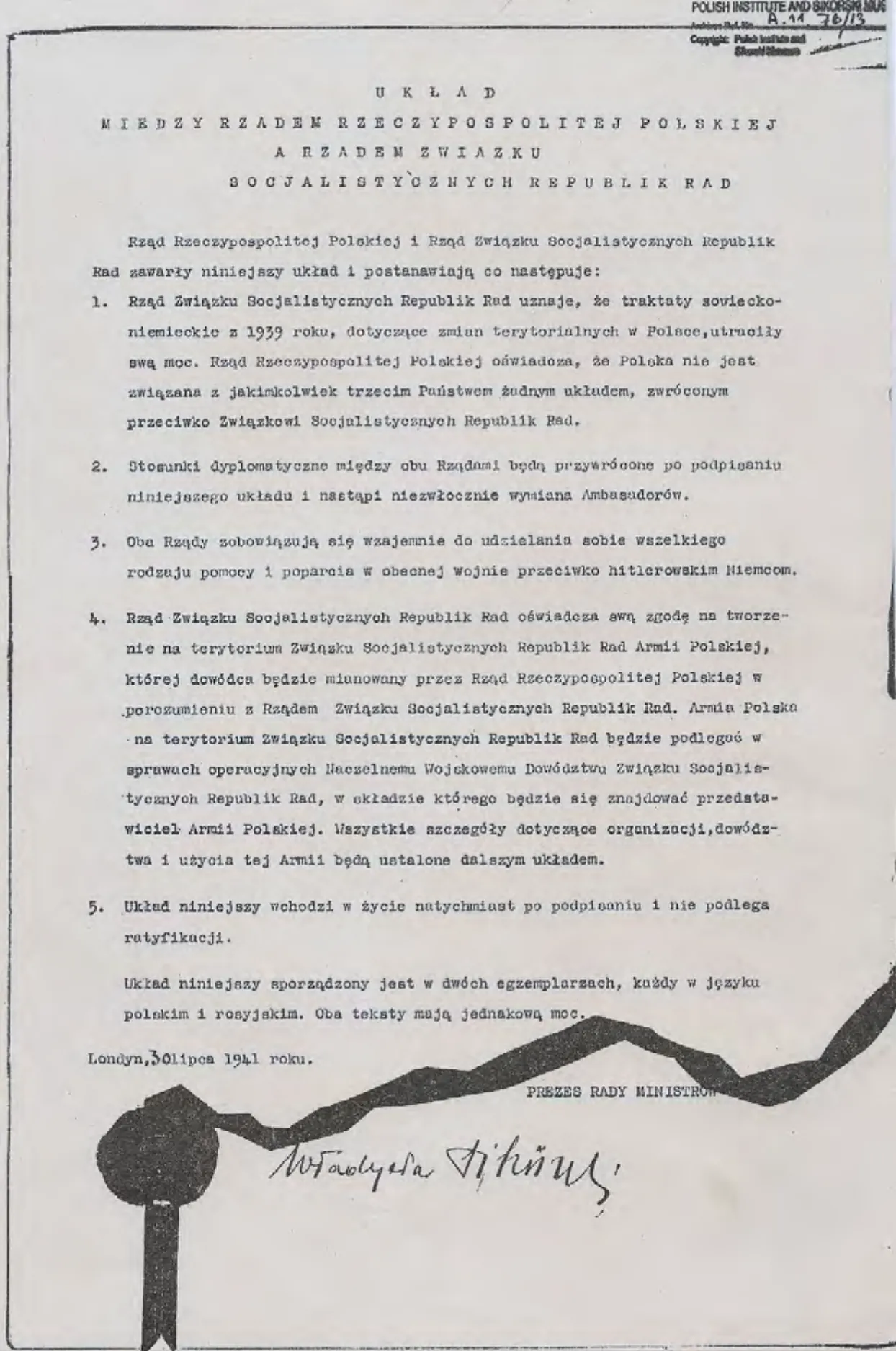
We learnt of the great defeats of the Soviet army in the war with Germany from people working at the Base, who had some information from newspapers and also talked with the Russians floating timber alongside them. My Father, too, while in hospital, read the Russian press and had plenty of fresh news from the front. Even the NKVD men who supervised us began to admit, with embarrassment, that their nepobedimaya strana, their invincible country, was suffering a humiliating defeat. With considerable delay the news reached us of the Agreement concluded in London on 30 July 1941 between Władysław Sikorski, Prime Minister of the Republic of Poland, and Ivan Maisky, the Soviet ambassador to Great Britain. Most important for us was that on 12 August 1941 the Presidium of the Supreme Soviet of the USSR issued a decree granting an amnesty to Polish citizens imprisoned on Soviet territory. In August 1941 the number of Polish citizens arrested, sentenced to labour camps, deported, held as prisoners of war or interned stood at 391,575. In all, 389,041 people were released under the amnesty9.
News of the amnesty reached us in mid-August 1941. The commandant called a meeting at Szomboziero of all the adult inhabitants of our two settlements. Nobody knew what the purpose of the meeting was. Both my parents went. After a short political introduction the commandant announced the decision on the amnesty, which came as a great surprise to everyone and was at the same time very moving news. The commandant told them that the Polish and Soviet governments had concluded an agreement and undertaken to fight together against their common enemy, Germany. All the inhabitants of our two settlements were amnestied, which meant that they would no longer be subject to the repressive authority of the commandant's office and would have the right to live freely anywhere in the USSR. All adults would soon receive udostovereniya, certificates of amnesty, and would be able to leave their place of exile and go to more hospitable regions of the USSR. Those present greeted the news with enthusiasm. They sang “Poland Is Not Yet Lost” and there was great rejoicing. When my parents came back from the meeting they were very moved and gave a detailed account of how it had gone.
The udostovereniya soon arrived, and it was decided that we would be able to leave fairly soon for somewhere in the south of the USSR, all together in one train. The district NKVD authorities in Onega worked actively with the representatives appointed by our compatriots to organise the departure. The destination of our journey was given as the town of Uralsk in north-western Kazakhstan. As it later turned out, this destination was purely theoretical, because in fact we bypassed Uralsk and went to Uzbekistan. The settlement commandant urged the Poles to stay in their place of exile as free people and go on working for the Onegales enterprise. It was clear that the loss of the cheap labour provided by the Polish exiles could seriously disrupt the enterprise's production plans, and as a result industry would not receive enough of an important raw material, timber. It turned out, however, that none of the Poles wanted to stay, not even such a toady and informer as Chajan. For Chajan the good times were over: we had been freed from the power of the NKVD, and had he stayed in the taiga he would have had to do heavy lumberjacking to earn his living. So he too declared that he wanted to leave with everyone else. After the amnesty my Father wrote to the District NKVD Commandant's Office in Onega asking for the return of his personal files, which had been sent there when he was deported, explaining that as an amnestied man he would be able to use them to document his qualifications so as to work in his profession. The office in Onega did not reply. We did not know when we would leave, but we realised that the journey by goods train would be long and that we had to lay in enough food to survive many weeks of travel. A family of five needs a lot of food. An additional worry was Father's illness: he had been discharged from hospital uncured and was unable to do anything to help prepare for the journey.
So most of the work of obtaining food fell to Mother and partly to my brother and me. Quite a few Russians came to our settlement interested in buying women's clothing, of which we still had some left to sell. We managed to sell a few things and had a few more roubles. Unfortunately there was nothing to buy with the money at Szomboziero, where the little shop had empty shelves. The nearest village, Verkhovye, was 15 km away, too far to walk there and carry back food bought from the locals. We decided to use the newly built railway, on which goods trains, and sometimes passenger trains, were already running. Three kilometres from Katiszcze, by the short cut, was Glazanikha station, where trains stopped, and the next station, Tesovka, was eleven kilometres further on towards the town of Onega. We decided to take the train to Tesovka in the hope of doing some good trade. I made two or three trips to Tesovka with Mother. We took a few things with us to sell and barter.
To get to Tesovka we first had to walk two kilometres through the taiga from Katiszcze to the railway line. On the way we passed a little cottage where a Russian named Chortov lived alone. Nobody knew what Chortov lived on or how he managed in winter, but people said he hunted and was also a sort of forest warden and had the means to support himself. When we reached the railway we still had to walk about a kilometre along the track to Glazanikha station, where we had to wait many hours for a goods train to appear. When one came in the late afternoon and stopped, we jumped into one of the wagons without asking anyone's permission. We rode this train to Tesovka, a small settlement of a few houses where people working on the railway lived. One of the locals advised us to walk along the lake to a settlement a few kilometres away, where we would be able to buy things. We set off in the direction shown, but it began to grow dark, so we turned back to the station. There we called at one of the houses, where we were received by a kind Russian woman, a railwayman's wife, who gave us tea, took an interest in our goods, and we did some bartering. In exchange for women's blouses we received flour, groats, oil and perhaps something else. Most important of all, she let us stay the night; true, we slept on the bare floor, but we were happy not to have to spend the night outside looking at the stars.
The second trip was even more successful in terms of trade, but on the way back we reached our station, Glazanikha, in the evening, when it was already dark. We decided to walk through the taiga by night and try to cover the two kilometres from the railway to Katiszcze in the dark. Unfortunately, when we reached the path from the railway to our settlement, it turned out that in such darkness we had no chance of getting there and would have to sit under a tree and wait for morning. But my brother had an idea how to beat the darkness. He suggested trying to light the path, and the best thing for that was birch bark, of which there was plenty, and we had matches with us. We stripped a lot of white bark from several birch trees, lit one piece, and found that the bark burnt very well and gave enough light to see a couple of metres of path ahead. Walking slowly, we reached our hut safely.
At the beginning of October 1941 we were informed by the commandant's office that in the next few days the inhabitants of our two settlements would leave from Glazanikha station for the south of the Soviet Union and that we should prepare for the journey. Finally we received notice to go to Glazanikha with our belongings, where a special train would be provided. From Katiszcze to Glazanikha, by the road through Szomboziero, was five kilometres, but because Father was seriously ill, and Mother, although she had recovered her health, was not fit to carry heavy loads, the job of carrying our belongings to the train fell to my brother Zbyszek and me. We had to carry it all on our own backs, and there was a lot of it, because besides our personal belongings there was a great deal of food prepared for the journey. I had turned thirteen on 6 October, but I was small and undernourished, with many unhealed sores on my body, and carrying our possessions was beyond my strength. To this day I remember how exhausted we were by all that carrying. My brother and I made two trips and got our things to the station. All the people waiting for the train tried to squeeze into the small station building. But the train had not yet come, and we camped at the station all night; there were about four hundred of us. Among those waiting was a dying woman lying on the station floor, and one could see life ebbing out of her. At last, the next day, 13 October 1941, fifteen goods wagons were brought. About 420 of us were leaving. Each wagon had to hold on average about 27 people. These wagons were adapted for carrying people, having two small windows with sliding panes, two-tier bunks and an iron stove in the middle. The Soviets had a large stock of such wagons left over from the four deportations of Poles in 1940 and 1941.
On 13 October 1941 we said goodbye to the taiga, leaving behind the whole weight of the worries and misfortunes that had befallen us in the 20 months since the day of our deportation; at last we had hope that our lot would improve, though it was only a hope.
To conclude my account of our stay in the Arkhangelsk Oblast, I would like to try to establish what became of the total of 1,818 people deported in one transport from Wołkowysk. Of these, about 500 went to Szomboziero and Katiszcze, while a second group of over 600 of our compatriots, who travelled with us to Kodino station and then to the village of Verkhovye, was sent to Tushilovo, a place deep in the taiga on a lake called Kozhozero, 135 km south of the town of Onega. At Tushilovo, as we did at Szomboziero, they occupied huts left by Ukrainian trudposelentsy. But a large group of Ukrainians remained near the Poles, living in their huts on the other side of the lake. The amnesty of August 1941 seems not to have fully reached the Poles at Tushilovo, as shown by the fact that almost all of them declared that after the amnesty they wished to stay where they were and did not ask to go to the south of the USSR10.
A third group of people travelling in the eshelon from Wołkowysk probably went to two settlements, Malye Izby and Volchanitsa. These were people who in February 1940 did not travel with us to the last station at Kodino but were detached from our eshelon earlier and sent to those settlements.