- Introduction
- Chapter I: My Family and My Town
- Chapter II: Deportation
- Chapter III: Amnesty
- Chapter IV: The Journey to Kazakhstan
- Chapter V: In Dzhambul
- Chapter VI: In Iran
- Epilogue
Chapter II
Deportation
Szomboziero and Katiszcze, Arkhangelsk Oblast, 1940–1941
The deportation of settlers and foresters took place on 10 February 1940. The people of Wołkowysk knew nothing of the Soviet authorities' preparations to deport Polish citizens. It was kept secret so that those on the list would have no time to escape. Early in the morning of 10 February 1940, while we were still in bed, four representatives of the authorities appeared at our home: a uniformed NKVD officer (of the People's Commissariat for Internal Affairs) armed with a pistol, a civilian, and two Red Army soldiers with rifles and fixed bayonets. Father let them in and then heard:
– Sobiraytes' s veshchami v dva chasa! (Pack your things within two hours!)
– A kuda my payedem? (Where are we going?) Father asked the NKVD man, but received no clear answer.
We were allowed to take food supplies, clothes, bedding and other personal belongings. Two sledges stood in the street in front of the house, onto which we were to load ourselves. My parents began packing, and we managed to take quite a lot, including a treadle sewing machine. We had time to eat breakfast, and our “guests” had a bite too. In fact we exceeded the two-hour time limit for packing, but packing was not easy, because we did not have enough suitcases and had to make bundles. My brother and I wanted to go to the privy outside. Father had to clear this with the official, and when we went out two Red Army soldiers with rifles went with us. Evidently they feared we would run away, although that was unlikely, since the frost outside must have been around minus 25 degrees. The temperature could not be read, because the window panes were covered with a thick layer of ice and hoarfrost. February 1940 was one of the harshest winters, and the frosts were hard to bear; even school had been suspended for a long time.
We left behind all the furniture of three rooms and a kitchen, as well as various appliances and kitchen utensils and more valuable items such as a bicycle, a double-barrelled shotgun, a Browning (revolver), a radio set, and the rich collection of books in Father's library, including some leather-bound volumes. On the wall of Father's study there remained a fine stuffed capercaillie, a trophy from some hunt. We left little clothing behind, apart from a round box containing Mother's five hats, which stayed in the wardrobe. Nor were we able to take all the food. According to the detailed notes Father made from memory once we were in exile, we left at home: 700 kg of potatoes, 300 kg of rye flour, 80 kg of sauerkraut, 35 kg of beetroot, 25 kg of carrots, 10 kg of onions, 20 jars of preserved vegetables, 5 litres of honey and 4 litres of wine. The wine was home-made from bilberries, and while we were packing Father let everyone present help themselves. Even I, an eleven-year-old boy, was allowed a few sips, but it did not agree with me (perhaps there were more than a few sips) and I was soon “giving back” what I had drunk. Since Father ran an office at home in connection with his work as forester and also held official cash, he drew up a proper report, which he handed to the NKVD officer together with the sum of 1,612 roubles, and obtained a receipt from him.
What we left of our household was the family's life's work, and it was confiscated by the invaders from the east. The food we left was also very valuable at a time when the shops had been empty since the Russians arrived and long queues for salt, sugar and other goods had appeared in the town. The deportations went hand in hand with organised plunder of the deportees' property, which fell into the hands of individuals who grew rich amid the prevailing lawlessness. What became of the things we left at home is not known. Mr Ciepłowski, our neighbour on Wileńska Street, with whom Father corresponded while we were near the White Sea, could tell us nothing definite about it.
Before the war Father kept his savings mainly in PKO savings books. The official carrying out our deportation did not allow Father to take any documents, so five PKO savings books totalling 11,500 złoty remained in his desk, together with shares, cheques and bills of exchange worth 2,500 złoty (altogether the equivalent of four years' salary for a forester). The post-war authorities never returned savings deposited with the Post Office Savings Bank, so as a result of the war Father's whole life's savings were lost, with the exception of a building plot bought in 1936 in Skarżysko-Kamienna, which came through the turmoil of war unscathed.
The packing was finished and Father began carrying the larger bundles out to the sledges waiting in front of the house, while Mother and I carried the smaller things. The sledges set off at noon towards the town and then towards the Central Station, about three kilometres from our Wileńska Street. At the station we saw a goods train made up of a great many wagons. The train was surrounded by soldiers, and people with their luggage were being loaded into the wagons. These were Polish railway wagons fitted with two-tier plank bunks so that more people could sleep in them. We were loaded into one of the wagons, where there were already some people. In the middle of the wagon there was an iron stove, and at the side a hole had been cut in the floor, boxed in with wood, which was to serve as a toilet. The wagon had large sliding doors that were shut and bolted from the outside by the guards; they could not be opened from within. Through the small rectangular ventilation windows near the roof one could look down from the upper bunk and see a strip of ground just a few metres from the wagon. About 30 people were loaded into the wagon. The toilet turned out to be a great problem, because once people began using it, in 25 degrees of frost everything froze solid. But the resourceful occupants of our wagon tried to clear it by heating a long iron rod in the stove, and with this rod they managed to unblock this important sanitary facility a little.
For two days the train still stood in the station, and during that time more people brought in from the Wołkowysk district were probably being loaded. Only on 12 February did the train move off, and nobody in our wagon had any idea where we were going. The next day we reached Baranowicze, a town about 120 km east of Wołkowysk. At Baranowicze our journey in a Polish goods wagon ended, and we were to continue in a Soviet goods train on the broad-gauge track, which had already been extended to Baranowicze from the former border with the Soviet Union. In our wagon there was an elderly lady of about seventy, for whom a relative came to Baranowicze, having obtained permission to withdraw her from the deportation, but she refused, preferring to stay with her closest family, with whom she had been taken from home. Soon after arriving at the place of exile the old lady died.
The stop in Baranowicze lasted five whole days, and only on 18 February did we transfer to a Soviet eshelon (transport train), better equipped for carrying people, and the train set off eastwards. The advantage of these Soviet goods wagons was that they had two small glazed windows that could be slid open to look out, and which lit the inside of the wagon. The middle of the wagon, the width of the sliding doors, was a common space with an iron stove. Only those on the upper bunks could look out of the windows; those on the lower bunks had to sit in semi-darkness, but they were warmer, because the iron stove stood on the floor and heated them more. We ended up on an upper bunk with a window, which gave us better contact with the outside world. The stove had a single ring, so only one pot could be put on it at a time, and the families took turns. There was a constant crush around the stove, since soup or porridge had to be cooked for 30 people, as well as water for tea. My brother Zbyszek had the bright idea of using the stove out of turn: he mixed a thin batter, stuck it to the outer casing of the hot stove, and so baked very good flatbreads outside the official rota.
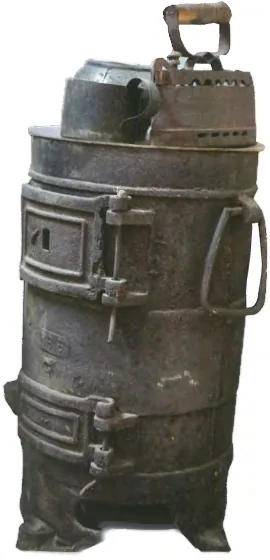
According to official figures, there were 1,818 people in our transport from Wołkowysk1. Assuming the norm was 30 people per wagon, one can estimate that the train, including the guards' wagons, consisted of about 65 wagons. We were escorted by soldiers of the NKVD Convoy Troops. The wagons were locked from the outside by the guards, and when the train stopped they were opened one by one so that people could relieve themselves. Then came the command: “Davay pod vagon!” meaning that one should get out of the wagon and do one's business outside. Translated literally, “pod vagon” meant under the wagon, but that could have been risky if the train suddenly moved off, and in any case there was too little room under a wagon for a crouching adult. In practice everything took place beside the wagon. During the journey we received a bread ration from time to time at the larger stations, and then the guard would shout: “Davay dva cheloveka za khlebom!” (send two people for bread!). Another frequent command was: “Davay dva cheloveka za vodoy!” (send two people for water!). Besides bread and water, we also received hot soup a few times during the journey.
We travelled east, stopping for somewhat longer at Minsk, Orsha, Smolensk, Vyazma and Mozhaysk, and reached Moscow. In Moscow came the command “Davay pod vagon!”, but the train had stopped somewhere far from the centre, and when we got out of the wagon we saw almost nothing of the capital of the mighty empire. In Moscow we turned north and travelled via Yaroslavl and Vologda towards Arkhangelsk. We stopped at Obozersky station, where a branch line ran north-west. At Obozersky there was an eshelon full of troops. When our Poles asked the soldiers where they were going, they would not answer. No wonder: they were bound by military secrecy. These were certainly troop movements connected with the Finnish front. The war between the USSR and Finland lasted from 30 November 1939 to 13 March 1940, and our encounter with the military train took place around 27 February. I found confirmation that troops were being carried along this line at that time in a report of 27 February 1940 sent to the People's Commissar for Internal Affairs, Comrade Beria. The report read: “Transport no. 4082 was halted en route on the morning of 26.02.1940 at Yemtsa station, about 80 km from its destination, because it was impossible to unload at Obozerskaya station, which was occupied by military eshelons”2. From Obozersky our transport went on north-west for another 50 km or so to the terminus at Kodino. Here the railway ended, and here our journey by rail ended too, though it was not the end of our journey. As I recall, Kodino was a sizeable settlement in the taiga, its buildings scattered over several hundred metres and surrounded by snow-covered spruce forest. Kodino marked the end of the first completed section of a railway that was to link the main Moscow–Arkhangelsk line with Belomorsk, 400 km away, which in turn had a rail connection to the ice-free port of Murmansk on the Kola Peninsula. At the time we did not know that there was a large labour camp at Kodino, whose prisoners, once the snow was gone, would resume building the railway to Belomorsk.
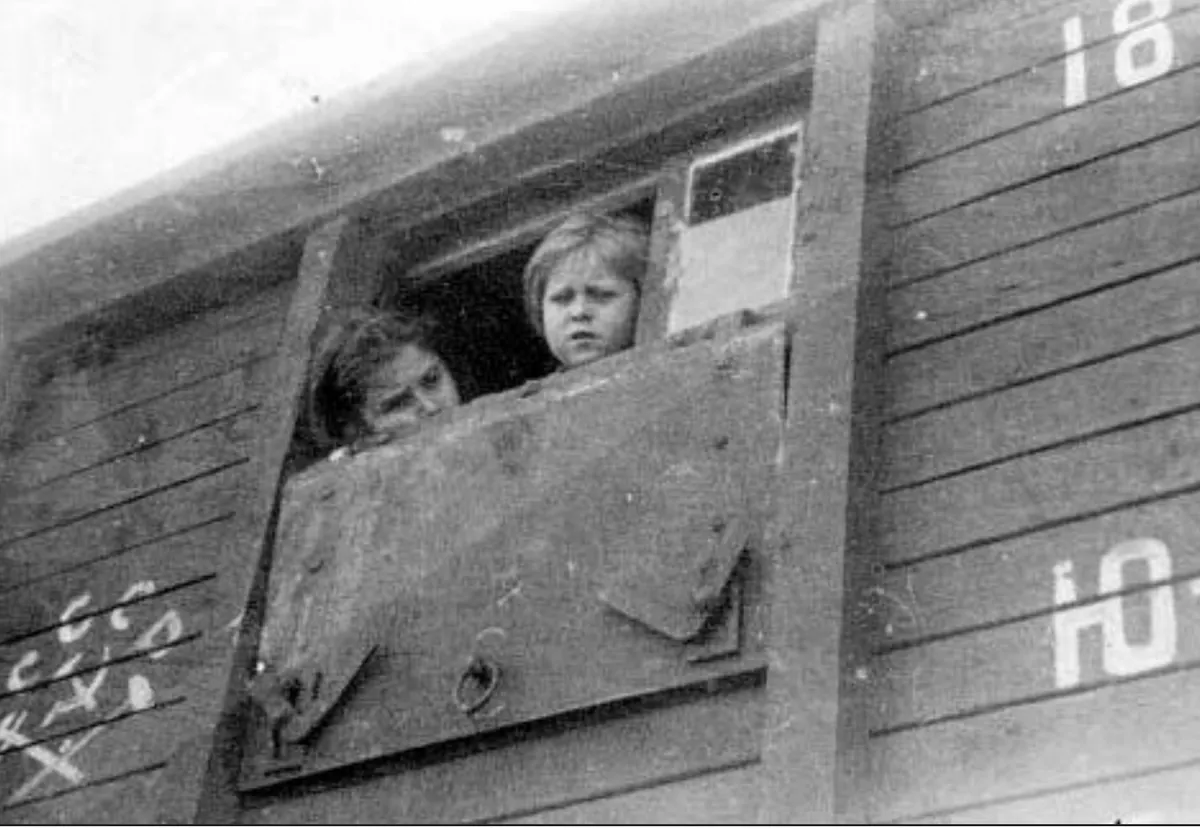
We stayed in the wagons at Kodino for two days. Only on the evening of the second day were we ordered to unload. A large number of horse-drawn sledges arrived, driven by carters, and we began climbing aboard in turn. Then we set off into the night in an unknown direction. Our izvozchik (driver) handled the sledge skilfully, but, as I remember, he had an inexhaustible supply of curses with which he urged the horse on. The horse was fairly intelligent and understood the meaning of the torrents of abuse perfectly well. After midnight, having covered about 35 km, we reached the village where we were to spend the night. The village was called Verkhovye; we stopped there and were all quartered, family by family, in the villagers' cottages. These were wooden, one-room cottages. The living room was upstairs, reached by a staircase, and on the ground floor there were storerooms of some kind. Our khozyayka (landlady) was a middle-aged woman who was kind to us and offered us tea made from dried forest berries. She greatly enjoyed our cherry preserves with her tea. She did have sugar to bite on, that is, lump sugar in hard irregular pieces, which was not stirred into the tea but held in the mouth while drinking chai, or tea. Since the villagers had been obliged to billet Poles, they received as payment from the authorities one litre of paraffin to light the cottage and a small ration of sugar. It was the last days of February, winter still held fast, and the village lay under more than a metre of snow. A sizeable river, the Mudyuga, flowed through the village, bound by a thick layer of ice. Near the village a large part of the river had been cleared of snow, and holes had been cut in the ice from which people drew water. After three weeks shut up in a wagon, I slid on the ice with great pleasure where the snow had been cleared away.
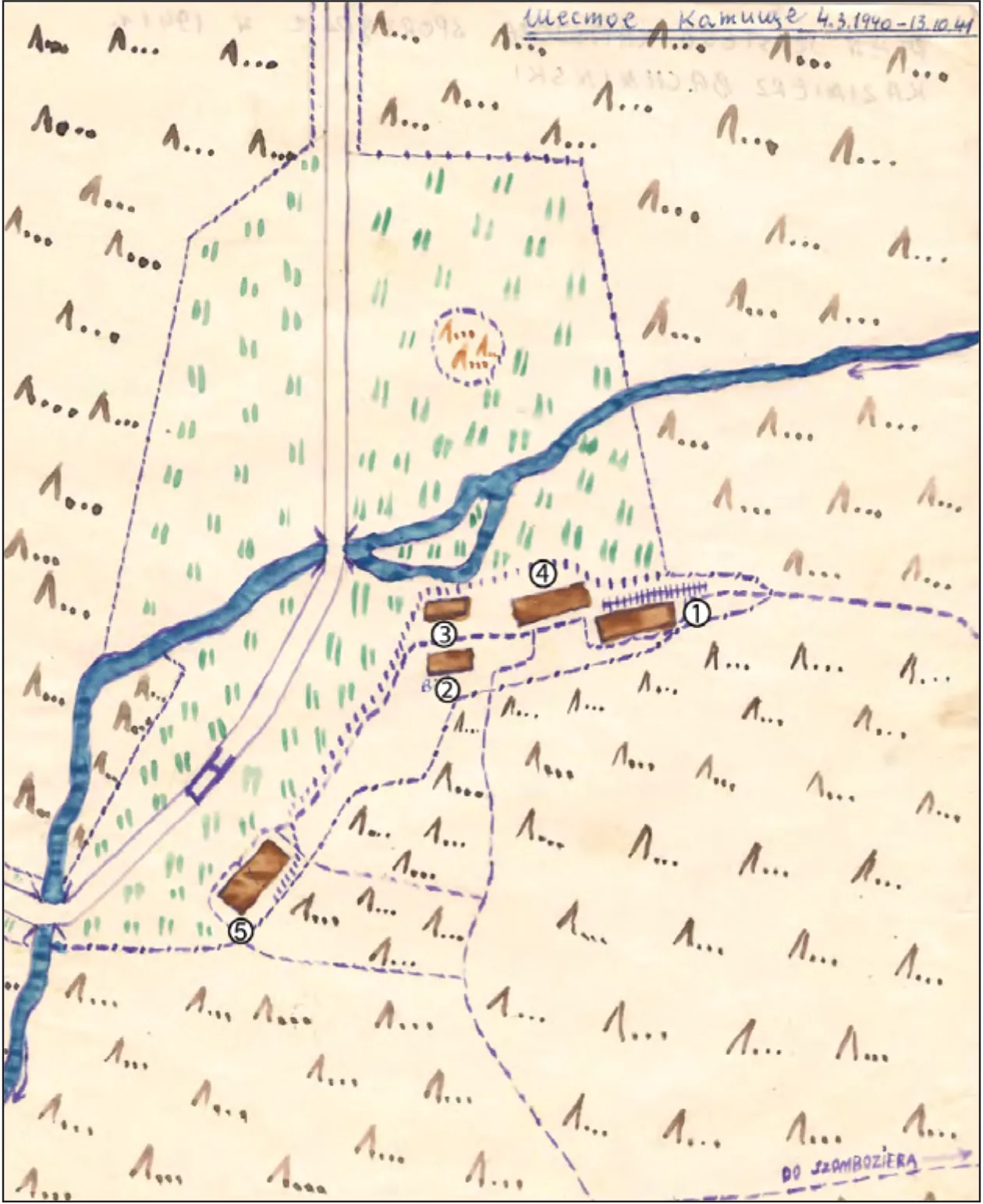
We spent three days in Verkhovye, and on the fourth day, 4 March 1940, sledges (podvody) were brought, we loaded ourselves and our belongings, and continued our journey. The end of our journey was near, since only a dozen or so kilometres of taiga separated us from our permanent place of residence. We reached a forest settlement known in the official language of the NKVD as spetsposyolok no. 68 (special settlement) named Szomboziero, and we were called spetspereselentsy, that is, special resettlers. The settlement lay on Lake Szomboziero and took its name from the lake. The lake was fairly large, about a kilometre long and up to three hundred metres wide, and lay in the midst of the taiga. When we arrived it was frozen and covered with a thick layer of snow, and along its western shore stood a row of a dozen or so huts, including several smaller ones housing the canteen, the banya (bathhouse), the shop and the bakery. Somewhat apart there was a hut where the commandant of the special settlement lived with his two assistants (militiamen), as well as the shop assistant and several other employees. A separate building served as a stable for the horses. Of our group of five hundred people who had come by sledge from Verkhovye, a large part unloaded at Szomboziero, but not all, for a smaller group of several dozen went on another two kilometres to a small settlement called Shestoye Katishche. The name can be translated as Timber Loading Point No. 6, and it was connected with earlier logging in the area and with timber being stored at this point ready to be hauled away. As it happened, my family was in the group sent to Sixth Katishche, and our driver took us there. In our settlement, Katiszcze, as we came to call it for short, there were only two living huts and two smaller huts, one housing the banya, or bathhouse, and the other the canteen. Beside one of the huts stood a ramp, a wooden structure which, before our arrival, had been used for loading logs. On arrival we unloaded our belongings from the sledges and took the place assigned to us in one of the rooms of hut no. 1 (the huts are numbered on the map on p. 34). Two other families were assigned to the same room with us. The room had one bread oven and three beds with straw mattresses, one bed for each family. Fourteen of us ended up in that room: my family of five; the family of Stefan Kolanowski, a forester from near Wołkowysk, also five, with his wife, two sons, fifteen-year-old Ireneusz and fourteen-year-old Jan, and a ten-year-old daughter; and the third family, Mr Chmielewski with his wife, a daughter in her twenties and an eighteen-year-old son. Chmielewski was a military settler and, like my Father, a former legionary. Living conditions in such a crowd were hard, but we had grown used to the crush during twenty days shut in a wagon. The men argued heatedly about politics by the stove, the most radical being Chmielewski. Both of them often laughed at Bachmiński because he could not chop wood for the stove and made strange, exaggerated movements while chopping. He clearly had no talent for physical work. But the rule was that the men took turns tending the stove, and each had to chop his share of wood.
The huts in which the Poles lived, both at Katiszcze and at Szomboziero, had been built by Ukrainians deported during the Soviet repressions against the kulaks and other “enemies of the people” in the 1930s. The Ukrainians had left the huts before we arrived, but what became of them we could not find out; they had dispersed somewhere. That does not mean these Ukrainians had been removed from the area altogether. Statistics show that on 1 October 1940 there were 40,130 so-called trudposelentsy in the Arkhangelsk Oblast, that is, people forcibly resettled for labour as part of the repressions against the Soviet Union's own citizens. There were somewhat fewer of these Ukrainian settlers than there were deported Polish citizens settled in the Arkhangelsk Oblast, whose number in 1940 was about 55,0003.
From what I saw, not all of us deportees were wealthy and well off. In our hut there lived a family with two boys a little younger than me who had no boots and wore lapti. Lapti were a kind of sandal woven from tree bark. In pre-war Poland the poorest people of Polesie wore lapti. In March 1940 there were still hard frosts at Katiszcze, yet my friends in their lapti did not get frostbitten feet. Wealthier people found it easier to survive here, because they had been able to bring personal belongings when deported, which could be sold here for the money needed to survive. Those who were poorer and had nothing to sell, living only on the low earnings of usually a single working member of a large family, soon found themselves in a critical situation. The wages were not enough for a family to survive physically.
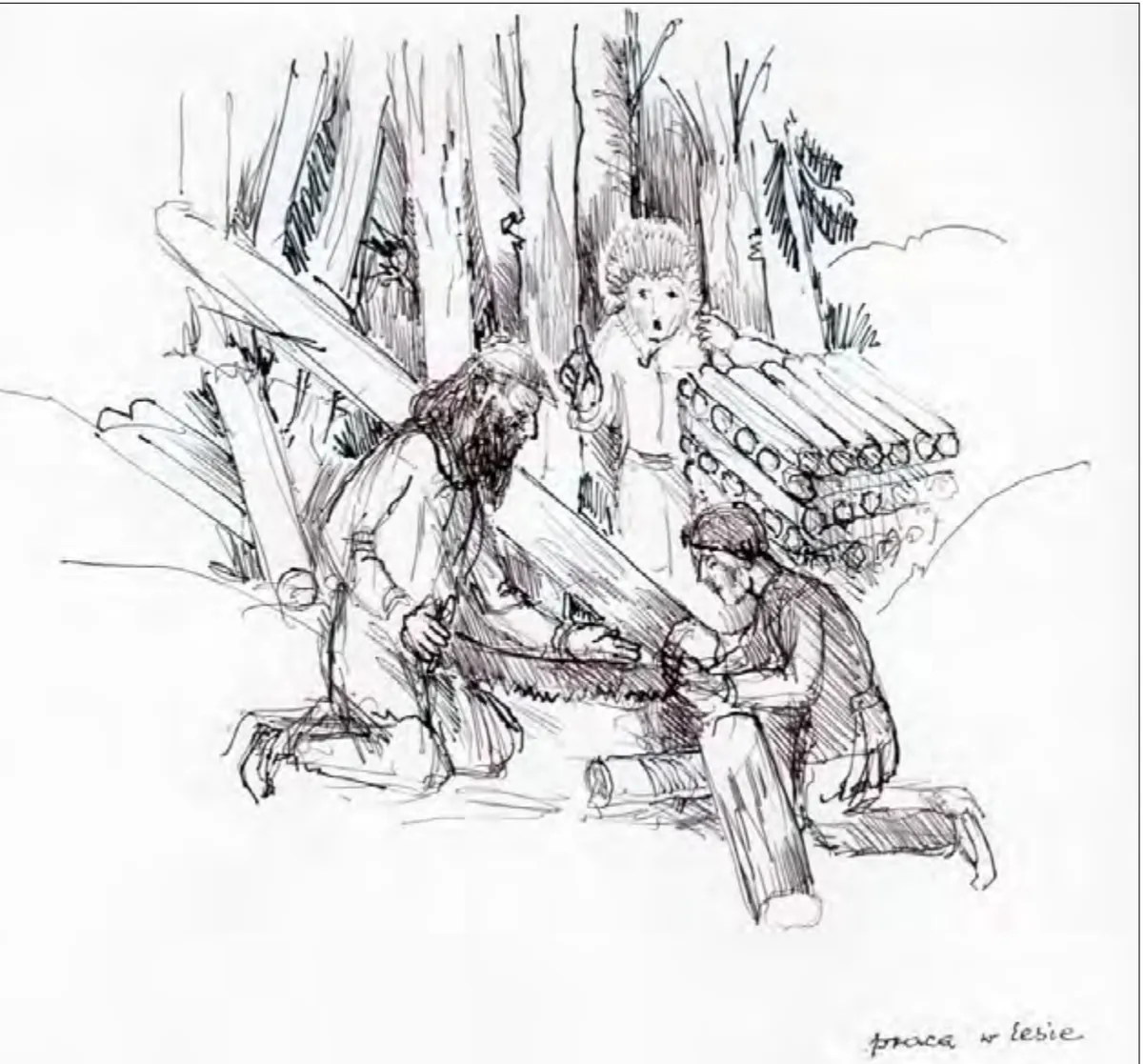
A few days after we arrived at Katiszcze, all the adults were mobilised for work. Near our hut there was an area where logging had begun. A large group of men was assigned to this work under a Russian desyatnik (foreman), a skilled lumberjack. They were given saws and axes, and the Russian showed them how to fell trees. I watched this work for several days and noticed that some Poles made rapid progress in acquiring the skills of a forest worker. But the master of this work was the desyatnik himself, who could fell a huge spruce single-handed in one go with a bow saw. Some of our people learnt felling, while others lopped branches, cut the felled spruces into shorter lengths, and stacked “metres”. Stacking metres meant that two people with a two-handed saw cut the felled tree into one-metre lengths and then piled these logs one on another to a height of one metre, forming stacks from one to several metres long. This wood was used for fuel, while the long lengths were taken to timber-processing plants for further working, or could be used on the spot to build living huts. Our people had neither proper work clothes nor warm boots for working in the open in the frost and frequent snow. The Russian desyatnik, on the other hand, was dressed perfectly: he wore an ushanka (fur hat with ear flaps), a quilted fufayka jacket and quilted trousers, valenki (felt boots) of hard felt on his feet and warm mittens on his hands. Many of our people, lacking warm clothes and boots, got frostbitten hands and feet and were then unable to go on working.
All adults and young people over sixteen were obliged to do physical work. The special settlement was a forced labour camp. Only the sick, or women caring for several children, could be exempted from work. At Szomboziero we had a medical post, where sick notes were issued by its feldsheritsa (medical assistant). The notes were handwritten on small scraps of paper but stamped with a round seal bearing the inscription: Arkhangelsk Oblast, Onega District, Medical Post No. 1. A Pole who avoided work without a sick note from the medical post could be tried for progul (unjustified absence). The trials were held at the Base, that is, at the work site on the Onega River, 20 km from Szomboziero, where a larger group of our compatriots worked floating timber. It was a district court that came from the town of Onega, 35 km away, and at its visiting sessions it considered the requests for punishment submitted by the settlement commandant and sentenced the accused under the Decree of the Presidium of the Supreme Soviet. One such trial was held against Jadwiga Wróblewska, who was accused of failing to report for work without proper justification. But she came out of it unscathed, because the court accepted a certificate from the medical assistant stating that Mrs Wróblewska's daughter had been ill and her mother had to look after her. Under the Decree, absence from work or evasion of work was punishable by six months of corrective labour at one's workplace with 25 per cent of earnings withheld, or by two to six months in prison.
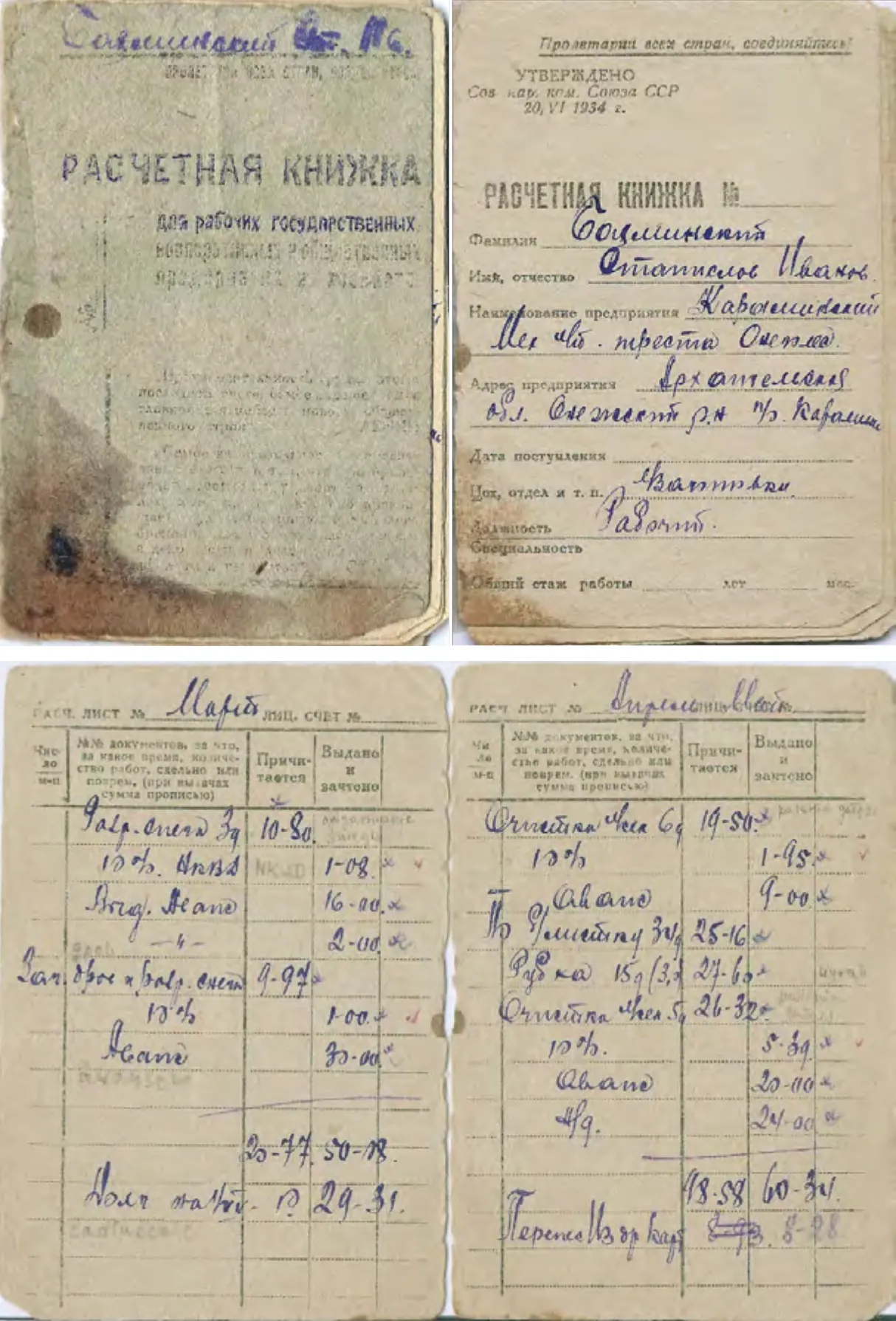
Work discipline was enforced by commandant Popov and, after Popov was recalled, by his successor Nikolayenko, together with two uniformed assistants, Yevseyev and Gusev, who went round the huts checking that everyone had gone to work. It is worth adding that they had a material interest in squeezing out work discipline, since the costs of the settlement commandant's office and of the District Commandant's Office in the town of Onega were covered by a monthly deduction of 10 per cent from the deportees' earnings. I find confirmation of this in my Father's pay book, where 10 per cent was deducted from every wage payment.
The inhabitants of the settlement were not allowed to leave their place of residence or work without permission. If the need arose, a pass issued by the commandant's office was required, or one from the district NKVD representative if the person concerned worked outside the settlement. In practice, however, we could move without a pass between our two settlements, Szomboziero and Katiszcze, and to Glazanikha railway station, and we could walk in the forest and pick berries. To go to the nearest village, Verkhovye, 15 km from Katiszcze, where potatoes and other vegetables could be bought, a pass was needed, but the commandant did not issue such passes.
The winter of 1940 was drawing to an end, and the snow, which lay a metre and a half deep, began slowly to melt and settle. On such settling snow one could walk on the surface without sinking in, because as it settled it became ever more compacted and bore a person's weight. But soon, around the middle of April, the thaw set in. The little stream flowing out of Lake Szomboziero, called the Szombruczej, which ran through Katiszcze, turned during the thaw into a torrent fed by meltwater.
When the winter was over, the people of Szomboziero and Katiszcze were sent to various kinds of work: logging, floating long timbers down the Onega towards the White Sea; and work on building the railway from Kodino to Belomorsk also got under way at great speed, and some of our compatriots found work there. In 1940 a 50-kilometre section from Obozersky to Kodino was completed, leaving another 350 km to Belomorsk. When the grass grew in the meadows, our people found work haymaking. This was considered the lightest work, not demanding much effort, so older people and women were sent to it. But it was seasonal and could quickly be lost, and it was also poorly paid, at 3 roubles a day.
At Katiszcze work began on a third living hut. Evidently the commandant had decided that the existing huts were overcrowded and fell short of the norm of 3 square metres per person. The building went ahead quickly. Among our people at Katiszcze there were some who knew the trade, so the hut rose before our eyes and by about May 1940 it was ready to live in. It was built in the same style as the old huts, of round, debarked spruce logs laid one on another. The logs were hewn flat where they met, so that they lay against each other along their whole length, and the joints were caulked with moss so that there were no gaps, which also gave better insulation. The hut had a gabled roof and small glazed windows. Some of the people from the two most crowded old huts were moved into it, and some people were also brought over to Katiszcze from Szomboziero, because the huts there were crowded too.
As it happened, my family was assigned to the new hut, while the Kolanowskis and Chmielewskis stayed where they were, in hut no. 1. Our new hut had one central entrance and two side entrances to the living rooms. In all there were twelve rooms in the hut. Every three adjoining rooms shared a stove in a common entrance hall, used for heating and cooking. Cooking was done by setting a pot on the glowing embers in the hearth. But there was no crush at cooking time, because the food brought from Poland soon ran out and there was nothing to cook, while the shop at Szomboziero sold only bread on ration cards, salt and paraffin for lamps. There was no groats, no flour and no oil to be had there, and one had to rely on meals from the canteen.
Our room was separated from the neighbouring rooms by a partition of thin boards about two metres high; above it was an open gap of half a metre, then a plank ceiling and above that the sloping roof. Through the thin partition one could hear everything that went on and was said next door, and worst of all, the partition was full of bedbugs, which were unbearable at night. Our room, about 15 square metres in area, had a small window looking out onto the stream and onto the tractor track, made of thin poles laid across the road on the wet ground. While we were there, the tractor track was not in use, because logging in the area had finished.
In our room there was a primitive wooden table, a bench to sit on, and in the corner a place to sleep, where at night we laid out a plank bunk with a straw mattress on top, and the whole family lay side by side. There was also a small bench by the wall for one person to sit on, where Daddy usually sat during the periods when he was unable to work and stayed at home. Next to us lived the Tereszkos. He was nearly sixty, a tall and very thin man, a distiller by trade, as he introduced himself, that is, a worker in a distillery. His wife was much younger, and they had a seventeen-year-old daughter. After the winter of 1940 all three went to work, mostly haymaking. They often worked together, or mother and daughter together and the father separately. Haymaking was not hard work, but one's head had to be specially protected against the midges, which bit cruelly on any exposed skin in those marshy meadows. Tereszko often came home from work earlier than his wife and daughter. Being hungry, he would put a large pot of water on our shared stove, bring it to the boil and throw diced bread into it. He called this dish kapłunek (“little capon”). As a worker he received 800 grams of bread, and with part of his ration he made this restorative meal. Its calorific value was small and it did not make up for the calories spent at work. When we lay down to sleep on the bunk, our heads were against the partition, on the other side of which were the Tereszkos' heads. There was little harmony between them; they often hit each other with pillows. Usually mother and daughter were in coalition against the father. The worst thing was that our shared partition swarmed with bedbugs and it was hard to fall asleep. Often before going to sleep we would light the paraffin lamp and the hunt for bedbugs would begin; in the light they were visible, and Mother killed them with a metal crochet hook. There were bedbugs between the ceiling boards too, and when people were asleep they dropped down onto the sleepers. I never saw these falling bedbugs myself, but everyone said that the bugs really had acquired this skill.
In the third room, beside the Tereszkos, lived the Paliński family. It was a family with a great many children; at the time I could not count them all. In fact there were nine of them: the parents and seven daughters aged from two to thirteen. Since Paliński was the only one working and his wife looked after the children, he could not earn enough even to buy the bread ration and the porridge or noodle soup in the canteen, and the children began to die. Five daughters died of hunger. I remember the death of one of them, an eleven-year-old, who was laid out in our entrance hall in an open coffin knocked together from boards; what struck me most were the lice crawling over the dead child's face. Such an image does not quickly fade from memory. I should add that in exile the Palińskis had yet another daughter. At Szomboziero there also lived three grown-up children of Paliński's from his first marriage, a grown-up girl and two young men aged 18 and 20. The two young men were very productive in the forest and became famous as “Stakhanovites”, that is, shock workers. They earned well and were entitled to special food rations of such things as sugar, sweets, oil and perhaps something else. The settlement commandant held them up to others as an example of how to work, but they did not have many imitators.
I would like to mention one more family living in our hut, the Matiases. They had been deported from the settlement of Kobylaki, a dozen or so kilometres from Wołkowysk. He had been a gamekeeper in the Wołkowysk Forest District. The Matias family had seven members, including a ten-year-old boy, Bolek, with whom I was friends, and eight-year-old twin girls who played with my six-year-old sister Hania. Bolek died of dysentery on the train in October 1941 during our journey to Kazakhstan. Matias often talked with my Father, and I listened to their conversations. One of them went like this: “Mr Forester, we should try to escape from here to Poland. We'll take baskets with some food and walk through the forest until we reach our homes in Poland.” I do not know whether he meant it seriously or only wanted to hear my Father's opinion. Father, of course, judged the idea impossible, since Wołkowysk was 2,000 km away. But Matias evidently talked about his escape plan more widely, and it must have reached the commandant's office, because Matias was arrested. He was arrested but not sentenced, and after some time he came home.
An elderly couple, the Pereszczaks, also lived in our hut. They were old people, quite unfit for heavy physical work in the forest, and not working they had no money to live on and faced the prospect of soon dying of hunger. To be rid of the problem, the commandant arranged a place for the Pereszczaks in a priyut, that is, an almshouse. The Pereszczaks went to the priyut, and how long they survived there nobody knows, because no news was ever heard from them. They were probably placed in a special Invalids' Home in the Pinega district, 200 km east of Arkhangelsk, where old people and invalids from the whole Arkhangelsk Oblast were sent.
After the Pereszczaks left, Mrs Jadwiga Wróblewska, who had been moved from Szomboziero to Katiszcze, moved into their room. My Mother became friends with Mrs Jadwiga, who had two children: a ten-year-old daughter, Irenka, and a five-year-old son, Marian. Mrs Jadwiga came from Józefowo near Wołkowysk, where she and her husband had a large farm with a beautiful orchard. The Wróblewskis stood out in the area for the size of their farm and the prosperity of their household. Mrs Jadwiga's husband was away from home at the time of the deportation: he had been warned of the planned deportation and had gone to Wilno to wait until the danger had passed. He escaped deportation, but in 1943, while at home in Józefowo, he was murdered in the fields by someone from the locality, which Mrs Jadwiga learnt only after the war, on returning home to Poland. Mrs Jadwiga often came to see us for a chat, usually with her little son Marian. Marian could already read quite well and showed off by reading from the first-year primer and reciting poems. His mother was delighted that her son was so talented. Her daughter Irenka began going to school in Szomboziero once the school year started.
Several times we were visited at Katiszcze by Mr Józef Korzeniowski, a forester from near Wołkowysk, who lived at Szomboziero; he brought books, and he and Father talked about current affairs. Mr Korzeniowski was a tall man and very obliging. He deserves my gratitude, because he helped us greatly in our need when we were in Kazakhstan in 1942.
Also living at Szomboziero were Mr Labocha, with his wife and daughter, and the Rozwadowski family. I mention them because we met them in Kazakhstan after leaving our settlement. Labocha, a forester by profession, visited my Father at Katiszcze several times. It was said of Mr Labocha that before the war he had grown rich by winning a lawsuit against a hospital for damages. He was in poor health, and when he fell ill he was taken to hospital, where his condition deteriorated so much that a doctor mistakenly pronounced him dead. He was taken to the mortuary, but the patient had not died; he regained consciousness, raised the alarm and was taken back to the ward. When he recovered, he sued the hospital for damages for the additional suffering and moral harm caused by his stay in the mortuary. Reportedly the would-be corpse was awarded substantial damages. At the settlement Labocha hardly worked, pleading ill health, but he must also have had many things to sell, because he ate reasonably well, and later he turned up with us in Kazakhstan, in the town of Dzhambul, in fairly good health.
In one of the old huts at Katiszcze lived a man named Chajan. It was with his son that I often walked to school at Szomboziero. In Poland he had worked as a gamekeeper. He had the appearance and manners of an educated man. He said that before the war he had been a communist, and complained that he had been deported by mistake, for which he bore a great grudge against the Soviet authorities. Chajan boasted that in September 1939 he had disarmed scattered Polish soldiers when the Soviets marched in from the east. When our overseer from the NKVD commandant's office, Yevseyev, learnt that there was among us a man who declared himself a communist and a lover of the Soviet Union, he made him his assistant, an informer watching over the Poles at Katiszcze. Chajan's duties included frequently visiting the families in the huts and reporting to Yevseyev any remarks or behaviour that might be considered hostile to the Soviet authorities or the communist system. Chajan spoke to the Poles in Russian, and his son Tolo also spoke only Russian. Besides his son he had a daughter with the Russian name Raisa, who was in the same class as me at school. Chajan often came to our hut, neatly dressed in officer's boots, and talked with Father about current affairs. I remember his frequent characteristic phrase: “Pan Bachmiński, ya vam skazhu takuyu veshch” (Mr Bachmiński, let me tell you something). These were calm conversations, without political disputes. Father knew he was dealing with a man who had chosen to collaborate with the authorities. Instead of going to work in the forest and ruining his health like all the other inhabitants of our settlement, Chajan enjoyed the privilege of not working. He must certainly have been paid by the commandant's office for his occupation. The fact that several people from Katiszcze were arrested must have been Chajan's doing. Matias was arrested, and so were our two roommates from hut no. 1, with whom we had lived at the very beginning after our arrival: Stefan Kolanowski and Stanisław Chmielewski. Kolanowski was sentenced to ten years' imprisonment for counter-revolutionary propaganda and agitation4. Chmielewski was indeed very outspoken, and it was easy to find evidence that he was an enemy of the Soviet authorities. Those arrested usually ended up in the prison in Arkhangelsk, where they awaited trial and sentence5.
The commandant's office was at Szomboziero; the commandant was at first Popov, who was later replaced by Nikolayenko. But for us at Katiszcze the most important representative of authority was Yevseyev, who had our settlement under his supervision. He was one of the two assistants of the special settlement commandant and had full authority over the inhabitants of Katiszcze. He often made the rounds of all the huts and talked with the inhabitants. He wore the uniform of an NKVD officer and carried a revolver in a holster. He was a fairly young man, a not very tall blond, although some said, probably out of spite, that he was ginger. He talked a good deal with my Father on various subjects during his visits. Father spoke fluent Russian, because in Sosnowiec, then under Russian rule, he had completed a Realnoye Uchilishche (secondary modern school) where the language of instruction was Russian. Yevseyev did not pursue my Mother for not working. Evidently he accepted that she was not fit for stacking metres and, besides, had to look after three children, including a six-year-old daughter who needed constant care.
In Mother's forest worker's book I found only one entry, from May 1940, confirming work and pay for nine working days. We had managed to bring from Poland a high-quality Singer treadle sewing machine, so Mother tried to earn a little by sewing to order for our people. But evidently she was not the best of seamstresses, and the orders soon dried up. Yevseyev approved of Mother sewing to order and once asked:
– Bachminskaya, vy portnikha? (Bachmińska, are you a seamstress?)
– Nyet, ya ne portnikha (No, I'm not a seamstress), Mother replied on the spur of the moment.
But she denied it because, not yet knowing Russian, she had taken the word portnikha to mean partaczka, a Polish word for a botcher, and thought Yevseyev was mocking her sewing skills. Only after Yevseyev had left was everything cleared up, and there was some laughter. Even so, Yevseyev remained convinced that Mother was a seamstress doing useful work, and did not chase her off to the forest or the haymaking. In any case, by June 1940, four months after our arrival, Mother was showing symptoms of hunger oedema; she had lost her strength and would not have been able to do any work.
From the day of the deportation my Father kept a daily record of important events. Thanks to it I can describe the course of his work from the moment we arrived at Katiszcze. At the very beginning he was given a worker's pay book issued by the Onegales enterprise, which gave his place of employment as the enterprise's branch at Karamino. Karamino was a village on the great Onega River, about 50 km from its mouth at the White Sea. At the mouth of the river stood the district town of Onega, seat of the district NKVD administration, to which our settlement commandant's office was subordinate. Onega was about 55 km from Szomboziero and Karamino about 20 km. Karamino was an important place for us, because it had the post office through which we received letters, and some people food parcels from Poland. Karamino was also the site of the tractor depot serving the whole area under the branch responsible for logging and transporting timber to the collection points. Near Karamino there was also a work site known as the Base, where timber was floated down the Onega towards the White Sea. The long floating timbers were hauled ashore at a place called Porog and went from there to a timber-processing plant. Floating began once the ice had gone, in May, and continued until October, when the Onega began to freeze. At the very beginning, after arriving at Katiszcze, Father was given work on the spot: in the first week loading logs, the next week clearing snow from the road by the huts, and in the following days logging. Having no insulated boots for spending long hours in the frost, he suffered severe frostbite of his big toe, as a result of which the medical assistant signed him off work for six weeks. During that time she came to Father several times and dressed the wound, disinfecting it with potassium permanganate, which I remember because of its purple colour. When his sick leave ended, at the beginning of May 1940, he was sent to lighter work, clearing the ground after logging and burning branches, and then, together with his thirteen-year-old son Zbyszek, clearing meadows. There was also a period of three weeks at the turn of May and June when there was no work for him and he stayed at home.
But the light work soon came to an end, and in mid-June 1940 Father was sent to work at the Base, where a larger group of Poles was employed floating long timbers down the Onega. It was one of the hardest jobs, consisting of hauling huge timbers to the riverbank by tractor or by hand and throwing them into the current. Father also did jobs such as barking birch and spruce logs, that is, stripping the bark from logs intended for floating. The Base was at Karamino, 20 km from Katiszcze. The workers employed there were quartered in huts and had a canteen on site with very wretched food; they could go home to Szomboziero or Katiszcze on Saturday after work, walking 20 km, but had to set off back on Sunday afternoon to be at work on Monday morning. Father came home only once a fortnight, because it was a long way: after a hard day's work it meant a four-hour march, and on Sunday, after a short rest, the same distance back. During the three months he worked at the Base, Father visited us at Katiszcze five times. I remember that he always arrived barely alive with exhaustion. He also told us that one day in the canteen he lost his temper when he was served oat porridge without any fat yet again; he flung his wooden spoon on the table and left the canteen hungry and furious. When he visited us he complained of dizziness and symptoms of the disease called tsinga in Russian, that is, scurvy caused by the lack of vegetables in the diet.
Those three months of hard labour, with no meat, milk, butter or vegetables in his diet, sapped his strength and ruined his health generally. And the pay for this work was low, considering that the money earned was supposed to support the family. According to the entries in Stanisław Bachmiński's pay book, from March to October 1940 he earned 570 roubles net (that is, after the 10 per cent tax deducted to cover the costs of the NKVD commandant's office). Under this pay system no benefit was paid for sick leave. Over those eight months his pay averaged 70 roubles a month, which was not enough to buy the bread ration and canteen meals for the whole family. A kilogram of bread cost 1 rouble 20 kopecks, a portion of oat porridge 35 kopecks and a portion of noodle soup 58 kopecks. A family of five had to pay 7 roubles 50 kopecks a day for bread and these canteen dishes, that is, 230 roubles a month.
Stakhanovites such as the Paliński brothers, who exceeded the set work norms and earned well, could afford to order meat soup, sup myasnoy, in the canteen at Szomboziero, which cost 1 rouble 5 kopecks. It contained a small piece of meat, but there was not much demand for so refined a dish. Although I was often in the canteen at Szomboziero, I never dared to treat myself to sup myasnoy, so I cannot say anything about its taste. I always ordered noodle soup or porridge. Salted mushrooms could also be had in the canteen, but they tasted foul and I took them only once, to try. At Szomboziero there was a little shop, which I sometimes looked into to see whether anything had been delivered that could be bought as a bargain. Once I met a couple of Polish Stakhanovites there who had come to buy boiled sweets and sugar with their special coupons, and I witnessed the following conversation:
– Yest' sakhar, yest' konfety? (Is there sugar, are there sweets?)
– Sakhara i konfet net (There's no sugar and no sweets), the shop assistant replied.
– A pochemu net? (And why not?)
– A potomu chto ne privezli (Because they weren't delivered.)
– A pochemu ne privezli? (And why weren't they delivered?)
– A potomu chto loshadey net (Because there are no horses.)
As one can see, transport difficulties also played a part in the lack of goods in the shop. In the end, though, the shock workers did get their ration of sweets, including arrears, sometimes several kilograms at once.
The summer of 1940 was fairly warm and dry, with little rain. The Szombruczej stream, which flowed through Katiszcze 50 metres from our hut and turned into a large river during the thaw, ran quietly in summer, and since the ground was marshy, in places it disappeared under the moss and was in fact invisible. The inhabitants of our hut took water from this stream for drinking and for all other purposes. In summer the days here were very long, and in July the sun set for only three hours: we had the so-called “white nights”, when one could even read without a lamp. When winter came, on the other hand, the sun appeared in December and January for only three or four hours, and the long polar night soon fell. This was because of our geographical position: the Arctic Circle was only three hundred kilometres away. After the third hut was built, our settlement, Katiszcze, had about 90 inhabitants, while about 400 people lived at the main settlement, Szomboziero. I cannot say exactly how many people came to our two settlements in March 1940, although it was said to be five hundred. According to the census taken by the commandant's office on 1 January 1941, there were 476 of us altogether. Of these 476 people, 51, or 11 per cent, declared Belarusian nationality6. After ten months in exile our number had fallen from about 500 to 476, because people had begun to die. After 1 January 1941, the date of the census, the inhabitants of our two settlements died even faster, mainly from malnutrition and diseases resulting from their weakened bodies. The dead began to be buried in the forest by the road, halfway between Szomboziero and Katiszcze. Because for ten months I went to school at Szomboziero and passed that cemetery twice a day, I saw how quickly the number of graves grew. It was said that in the end there were about a hundred graves. By my own estimate, based on the list of names of people deported to the Szomboziero settlement7, the number of deaths in our two settlements over 19 months was about 65, or 13 per cent of the original number.
Our exiles were under the constant watch of three officers of the commandant's office, whose task was not only to extract the maximum from forced labour for minimum pay; another important aim of these representatives of authority was to catch those who spoke critically about the Soviet Union, the NKVD, or the system of forced labour. People considered dangerous to the authorities began to be repressed, which meant arrests. Those arrested were sent to Onega for further interrogation and then ended up in custody in Arkhangelsk, where they were tried by the NKVD Special Board or the Oblast Court and usually sentenced to five or ten years in a labour camp, a gulag. In the autumn of 1940, when Father was working on the construction of the railway near Glazanikha station and I went to visit him at work after school and was walking back to Szomboziero, I saw an NKVD man, revolver in hand, marching 25-year-old Anatol Rozwadowski, handcuffed and a few steps ahead of him, towards Glazanikha under arrest. On the same day 19-year-old Stanisław Korzeniowski was also arrested. Both were tried in Arkhangelsk and sentenced. Korzeniowski received five years in a gulag for counter-revolutionary propaganda and agitation8. Several other young men whose names I do not know were arrested at Szomboziero. One may assume that about ten people in all were arrested from our two settlements. After his sentence Anatol Rozwadowski was sent to the labour camp at Kodino, whose prisoners worked on building the Obozersky–Belomorsk railway, but sadly he did not live to see the amnesty and died in that camp in 1941.
The short summer of 1940 passed quickly. I walked a great deal in the taiga, getting to know the nearby forest. Through our settlement, along a broad cutting in the forest, ran a road towards the town of Onega; it was no longer used to haul timber, but it was useful to me, as I could walk along it in a straight line, stepping on the poles laid across the road to reinforce the marshy ground. It was a so-called “wooden road”. Along this road, on the wet ground, grew berries like raspberries called moroshka (cloudberries), growing low on the ground, red at first and orange when ripe; they were valuable as a source of vitamins, though rather sour and not very tasty. I most liked picking bilberries, of which there were plenty, and on the marshes I found precious cranberries, but only in small quantities. There were also mushrooms in the forest similar to our saffron milk caps, but they were exceptionally unpalatable, so we did not pick them. Sadly there were no ceps, no birch boletes and no slippery jacks, which we knew from Poland. There were hares in the taiga, but nobody hunted them, because we had no firearms. Hares, as everyone knows, are fast and cannot be caught. But there was a time when some people managed it. In early summer young hares were born, and we boys from hut no. 5 organised group chases after the leverets. When a leveret appeared near the hut, the whole gang of boys would rush after it. Since there were heaps of branches in the forest, the hare would run into them, which slowed its escape, and often it got well and truly tangled in the branches, and then it was ours. Unfortunately neither I nor my brother Zbyszek ever won at this hunt, and some other family had the feast. There were no fish in the stream by our hut at Katiszcze to supplement our diet. I tried a few times to fish with a rod in Lake Szomboziero, but my catches were very modest. Above all, I did not have a proper rod. I made a hook from a sewing needle, which I annealed and bent into shape, but the hook must have had some flaw, because I caught almost nothing.
Beside our hut, on a rather sandy hillside, we found a patch of cleared ground, that is, with the roots of felled trees removed, and on this plot we and a few neighbours planted potatoes. But the harvest was quite wretched, because once the layer of forest litter was removed the soil was sandy, without organic matter. One of the inhabitants of our settlement, however, Mr Filik, planted a large patch of potatoes on flat ground near our plot, and he grew great luxuriant shoots and soon dug up splendid tubers. The secret of his success was soon revealed. Filik, an expert in cultivation, had spotted that near our hut there was a place where a stable had once stood and a good deal of horse manure had been left, and there he planted his potatoes. It was no man's land, and whoever took it first gained the right to use it. The agricultural knowledge and sharp eye of the man who had spotted it paid off. I should add that the great majority of the inhabitants of our two settlements were farmers. After Poland regained independence they had been given land as ordinary settlers or as military settlers. A small group at Szomboziero and Katiszcze were gamekeepers and foresters (Walerian Wysocki in his Memoirs says there were only ten foresters there).
There were no wolves in the taiga, but there were elk and bears. Although I walked a great deal in the taiga, I never met a bear. Janek Czarniecki, who lived at Szomboziero, told us that near their settlement he had come across a she-bear with her cubs, but fortunately he withdrew quickly without being noticed. A few other people also told of meeting brown bears, but none of them was attacked. In winter, walking along the road, one passed many rowan trees with beautiful red berries. But rowan berries were not fit to eat because of their tart taste, and nobody picked them. In winter I usually went to school on skis. When snow had fallen in the night, on my way to school in the morning I would see many animal tracks crossing the road. But they were not the tracks of large animals, only of smaller ones such as hares, martens, foxes and others that I could not identify from their tracks.
All the inhabitants of our two settlements suffered from malnutrition. Some who had family left in the territories occupied by the Soviets wrote to them for help, and food parcels containing pork fat, butter, oil and sugar did indeed begin to arrive. Thanks to these parcels people could briefly improve their physical condition. Mother bought a pat of butter from someone who had received a food parcel, but the butter was rancid and tasted bitter. Even so, we soon ate it, and it was the only butter I ate during our whole stay at Katiszcze. The inhabitants of our two settlements also began corresponding with their families, although incoming letters bore the marks of censorship. Sometimes the censor would cut out with scissors sentences containing what he considered harmful content. In fact we were cut off from political news about the war going on in Europe. Some people received coded information about current events in their letters, but it was not encouraging. I witnessed a letter arriving for one of the families in hut no. 1, which was read aloud to a larger group of neighbours. It began: “In the first words of this letter, praised be Jesus Christ. We are well, and wish you the same.” This was a formula commonly used at the start of a letter. Further on there was a coded message about the political situation in western Europe. It went more or less like this: in our village Nikodem had a quarrel with Bolek, Franek and Antek, it came to a fight, and Nikodem won. Everyone guessed that Nikodem stood for Niemcy (Germany), Bolek for Belgium, Franek for France and Antek for Anglia (England). The letter had been censored, but this coded message had been let through because it was politically neutral, while in a couple of places the censor had used his scissors. Such coded information was of little value, but I saw how eagerly people drank in this news, although it gave no hope that anything might change for the better for us here in the taiga. In fact we knew little of what was happening in Europe, and this was the time when Germany was conquering Denmark, Norway, Belgium, Holland and France, and the friendship pact between Germany and the USSR was still in force.
We never received a food parcel from Poland, since we had no close relatives on the Soviet-occupied side, and from the part of the country occupied by Germany, where we had family, food parcels could not be sent. We received only one parcel, containing clothes, from Mother's sister under German occupation in Suchedniów (Kielce Voivodeship). These things had little commercial value, but they could be sold to Russians. To save ourselves from hunger we began selling various things we had managed to bring with us from Wołkowysk. They were bought by Russians who came to our settlement to shop. These were officers supervising the labour camps, sometimes officials from Onega or people supervising the railway construction, often accompanied by their wives. The things we had to sell were eagerly bought, since they were of good quality and such things were not to be had even in their big cities. There was, though, one Russian woman from Leningrad who bought something from us and claimed that in Leningrad one could buy things as good as ours. Most valuable of all, however, was that in many cases the Russians paid not only in roubles but also in kind, for example with oil, flour, groats and, in winter, frozen fish.
The buyers must have arranged their trading visits to our huts with the commandant, since Yevseyev did not interfere in these matters and did not pursue either us or the buyers for trading. We had brought quite a lot of valuable things from Poland, and selling them gave us money to buy bread and canteen meals. I still have the list of things we sold, the most valuable of which was the Singer treadle sewing machine, for which we were paid 1,250 roubles plus 6 kg of fish, a litre of oil and 6 kg of wheat flour. There was a second valuable transaction paid in cash and food: for Mother's “English” suit we received 300 roubles and 10 kg of frozen fish, 15 kg of bread, 6 kg of wheat flour, 4 kg of peas and 1 kg of pork fat. We kept the fish for several weeks in the sub-zero temperature outside the hut, hidden under the firewood. The fish lasted for many meals and was especially welcome on Christmas Eve, 24 December 1940. According to Father's notes, for all the things we sold we received 4,900 roubles in cash, and the food we received was worth 430 roubles.
The inhabitants of our settlement were condemned to wretched food that led to loss of strength and deteriorating health. All one could buy was bread on ration cards, the so-called payok, a ration of 800 grams for a working person and 400 grams for a non-working one, and in the canteen there were usually two dishes: oat porridge and a flour soup, the so-called zacierka, made with water and perhaps flavoured with a few drops of oil. At first the poor diet did not show in people's health, but after a few months people began to fall ill from undernourishment. Infectious diseases also appeared, such as typhus and dysentery, as well as night blindness, whose sufferers could see nothing at dusk. Mrs Kolanowska, our former roommate from hut no. 1, fell gravely ill with typhus. I once met her on my way to Szomboziero as she was being carried back to Katiszcze on a volokusha (drag sledge), her head shaved, returning from hospital. People also began to suffer from scurvy, which, like night blindness, was caused by the lack of vegetables in the diet. A dangerous disease linked to malnutrition also appeared, called hunger oedema or hunger disease. The swelling began in the lower legs and moved upwards until it reached the abdomen, while the sufferer lost strength. According to the medical definition, “hunger disease is a set of symptoms occurring in starvation, with a particular deficiency of protein and vitamins. Its most characteristic symptom is so-called hunger oedema, such as dropsy of the lower limbs and abdominal dropsy."
The Soviet authorities can be accused of a deliberate method of bringing about the death of many deported Poles by forcing them to do hard labour in the taiga on starvation rations, with no meat, vegetables or fats. In our settlement one could hear officers of the NKVD commandant's office say things like:
– My vas zdes' privezli, chtoby vy podokhli (We brought you here so that you would croak).
or
– Nichego, ne pomryosh', a kak pomryosh', pokhoronim (Don't worry, you won't die, and if you do, we'll bury you).
or
– Kto ne rabotayet, tot ne kushayet (He who does not work, does not eat).
These last words were taken from Lenin. Remarks of this kind were quite frequent. The representatives of authority also often repeated that we had been deported here navsegda, that is, for ever. For us Poles this was a very painful truth, borne out by the example of the deported Ukrainian kulaks, who had not been able to return to Ukraine.
I have in my possession a letter written by my Mother to her mother and sister, who lived in the Kielce Voivodeship under German occupation. It is a kind of document describing our situation after four months in exile. Here is the verbatim text of the first part of the letter:
“2 July 1940. Sixth Katiszcze. Soviet Russia [...] I shall describe to you the sad moments of our life that we have been through and are going through now. On 10 February this year we were taken from our home at gunpoint and deported to Soviet Russia, to the White Sea near Arkhangelsk. We were allowed to take clothes, underwear, bedding, a little food and a few pots from our home; everything else we left behind: furniture, china, pictures, 300 kilos of flour and other things. This is already my second letter, because the first surely never reached you. We live in the forest, 50 kilometres from the railway, in huts with several families together; our room is 5 metres long and 3 metres wide. We live only on bread, water and noodle soup, plain or with a little oil; no fats of any kind can be had here, sometimes there are groats, we never see milk, as there is no village anywhere near, we deportees are alone in the depths of the forest. There is a Soviet kitchen here where they cook food for us, and apart from that we cannot buy anything to live on. We have to pay dearly for these meals. Everyone here works as a forest labourer, felling trees, stacking metres, loading timber onto tractors, floating it and so on. Henio worked in the forest, and in winter even I with Zbyszek and Kazik stacked metres. Then Henio got frostbite in his feet, so that for a month he could not go to work. Now he works at the Base 20 kilometres from home and comes home every two weeks. His work is hard; he rolls timber into the Onega River, whole logs, it is piecework. He cannot earn enough for all of us to live on, so I am selling the dresses I brought, whatever I have, so as to survive with the children. I cannot work myself, because I have no strength. My legs are swelling from lack of food and the damp climate; the air here is unhealthy, nothing but marshes and lakes. Life is very hard and sad for us; may God let us return to our own parts. Dear Mother and Mania, such a hard fate has befallen us; perhaps you could help us a little by sending a food parcel with butter, pork fat and sugar. Everyone here receives eight-kilo parcels from Belarus. Mania, find out whether parcels can be sent from you to Russia, because I have no fat left, everything I brought from home is gone. We are as if in prison; we are not allowed to go anywhere or move a step away, because we are watched. We do not know whether we shall ever get out of here, or when; perhaps never [...]”
This letter is an important document illustrating the hopeless situation in which we found ourselves. I was able to follow the course of hunger oedema at close quarters, because its symptoms appeared in my Mother. At first her legs began to swell around the ankles, and it did not look serious, but then the swelling spread to her whole legs and began to move ever higher. What was astonishing was that the symptoms had appeared as early as June 1940, only four months after we arrived at the settlement. We had some medical care in the form of the medical post at Szomboziero, run by a medical assistant, but she had no medicine for hunger disease. It must be admitted that in cases of more serious illness the medical post referred patients to the hospital at Chekuyevo, a village on the Onega River 40 km from Katiszcze. In September 1940 my Mother was referred to the hospital, when the swelling had already reached her waist and she was very weak altogether. Because Mother was being sent to hospital, Father, who was working at the Base, began trying to get a transfer to work closer to Katiszcze so that he could look after the children while his wife was away. The NKVD officer supervising the Base agreed to transfer Father to work nearer home. This was work on the construction of the railway near Glazanikha station, 5 km from Katiszcze. According to Father's notes, his work on the railway consisted of clearing the route on which the tracks were to be laid. To build a railway, the taiga first had to be cut to create a treeless corridor, the stumps of the felled trees grubbed out, the ground consolidated, embankments raised where the ground fell and cuttings dug where it rose, and finally the track laid. The line ran straight ahead and often crossed marshland, which took extra effort to stabilise, and the necessary bridges also had to be built.
Father worked on the railway only briefly, but he got into serious trouble there because he tried to buy from one of the prisoners working there a pair of valenki, tall boots of hard felt, good in frost, which he needed for the winter. Someone denounced him to the commandant over this transaction. Such trading with prisoners was forbidden. Father did not want to talk about the details of the incident, but he was locked up for it in the cells at Szomboziero, although he was released after a few days.
The railway linking Obozersky with Belomorsk was being built at great speed, using large numbers of zaklyuchonnye, that is, prisoners. The prisoners were supplied by the NKVD's Main Administration of Northern Railway Labour Camps, Soroklag. Construction by prisoners was organised so that every few kilometres a labour camp, a lager, also called a penal colony, was set up, in which the prisoners lived in makeshift wooden huts surrounded by a high fence with two watchtowers, from which the strelki (armed guards) kept the whole colony under observation. These penal colonies, kolonny in Russian, were numbered, and once the assigned stretch of work was finished the prisoners were moved a few kilometres further on, where a new colony was set up. One of these colonies was near Glazanikha station, and when the prisoners left it after finishing their work, I had the chance to walk round the abandoned huts. The huts were built of planks as makeshift quarters for the prisoners close to the construction site. I went there hoping to find something of value. In the summer of 1940 construction was in full swing near Glazanikha station and advancing rapidly towards the town of Onega. The following year, 1941, passenger trains were already running on the line to Onega. One day at Glazanikha station I sold bilberries I had picked in the forest to the passengers of one such train. One of the passengers talked to me and asked about the fate of the deported Poles living in the nearby settlement, and at the end praised me for being so good at selling, saying: “Vot molodets malchik!” (What a clever lad!). The railway from Obozersky to Belomorsk was of strategic importance, since it provided a safe link between the Moscow region and Murmansk, the ice-free port on the Kola Peninsula. Work went on simultaneously at various points along the planned route, which speeded up construction. When war with Germany broke out on 22 June 1941, and the Germans very quickly, on 8 September, encircled Leningrad, and in October 1941 the battle for Moscow began, the rail link to Murmansk bypassing the Leningrad area became very important, because from December 1941 American and British convoys with military equipment began arriving in Murmansk. This equipment could reach the rear of the front from Murmansk without hindrance along the new railway via Belomorsk to Obozersky and on south towards Moscow. I imagine that the NKVD's Main Administration of Northern Railway Labour Camps, with its vast reserves of camp prisoners, mobilised them so that the railway could be put into service quickly. But we left our place of exile in October 1941 and could not see whether transports of military equipment were running from Belomorsk through Glazanikha.
It should be mentioned that the Soviet authorities were capable of mobilising huge numbers of prisoners to build important projects. So it was in 1931–1933, when the White Sea–Baltic Canal was built. More than 100,000 prisoners were mobilised to build the canal linking the White Sea with the Baltic, and this great canal was built in less than two years.
Since Mother had been referred to the hospital at Chekuyevo, Father obtained permission from the commandant's office to take her there, so he broke off his work clearing the railway route and had to find some means of transport. The commandant's office gave him a podvoda in the form of a volokusha with a driver. A volokusha was a kind of short sledge drawn by a horse, certainly not very comfortable for carrying a sick person, but a wheeled cart would not have been much better on those narrow forest roads. Volokushas were used here in summer and winter alike. Chekuyevo was 40 km away; the little settlement with the hospital lay on the Onega River. The journey to the hospital by this conveyance must have taken several hours, and Father had to walk back. Altogether the trip to Chekuyevo took him four days.
While Mother was in hospital, from 24 September to 24 October 1940, a whole month, Father worked somewhere near our settlement, but his diary ends on 30 September 1940, and there is only a note that after returning from Chekuyevo he spent the last days of September burning branches left after logging. While Mother was away, my brother and I went to school at Szomboziero, and our six-year-old sister stayed at home alone. As I remember, our biggest problem at that time was lice. Wanting to get rid of them, I had to do something. I should add that on 6 October 1940 I turned twelve and was grown-up enough to solve this difficult problem on my own. I took the cover off the quilt and the pillowcases, added the sheets, carried the lot to the banya, or bathhouse, threw it into a large cauldron of water, lit a fire under the cauldron and boiled the bed linen for a long time. I hoped the lice would be boiled to death and we would be rid of them once and for all. Alas! When the bed linen had dried and our family bed was made up for the night, the lice went on biting cruelly. The battle against lice was hopeless, and they stayed with us to the end of our time at Katiszcze, and afterwards in Kazakhstan, and even later in Iran.
Mother's treatment in hospital went well, as we learnt from the two postcards she sent. Here is the text of the first, dated 1 October 1940:
“My dears! Today is my sixth day in hospital. My health has improved, but the swelling has not yet gone down. The doctor says that after 14 days the swelling will begin to subside. So my stay in hospital is expected to be longer, from 3 to 4 weeks. May God let me get through this. The food here is good, milk-based. I am also taking medicines. I wonder whether you, Henio, are working at Glazanikha or near home. Are the boys going to school? The children must dress warmly. Hanusia must wear her tights and winter coat. Zbysio and Kazio must keep the house tidy. They should salt the mushrooms. Try to buy berries and make preserves. When I am to come home I shall let you know by postcard or by telephone to Glazanikha. Potatoes, cabbage and onions can be bought here, so bring sacks with you. When I have to travel back, as soon as I write, ask the commandant for a cart [...]”
After a month in hospital Mother's swelling had gone, but, as she wrote of herself from hospital, she was weak and needed a cart to get home. Father obtained a podvoda and went to Chekuyevo to bring Mother back. When she returned she told us that she had had a very kind doctor. When she was completely well, he shook her hand and said: “Warsaw is ours!” Mother guessed that he may have had some family connection with Poland, but did not want to admit it.
I would like to describe an incident that took place at Katiszcze in late autumn 1940. An old woman went alone deep into the taiga with a basket to pick berries and could not find her way home. When it grew dark her family began searching, but without result, because the taiga stretched endlessly in all directions, full of bogs, marshes and fallen trees. Their calls went unanswered. When day came, the people of Katiszcze were mobilised and a larger search began. A whole day of searching by a considerable number of people brought no result, and the missing woman spent another night somewhere in the taiga without warm clothing, while the temperature at night could already fall below zero. On the next day Yevseyev joined in organising the search, and a great many people from Katiszcze took part. One of the searchers came across the woman sitting under a tree, half-conscious, frozen and close to death. Thanks to the solidarity of her compatriots, everything ended happily.
I have already mentioned that I went to school.
The school opened in July 1940. Since there was no free hut in which to hold lessons, a new hut was built for the school. Like all the others it was built of long round spruce logs, but it was small and had a single classroom. The hut stood near the lake on marshy ground. It was built on piles driven into the wet ground. The piles were tarred, and the tar came from a tar kiln. To make tar, grubbed-out tree stumps were thrown into a deep pit, a fire was lit, the smouldering wood was covered with a layer of earth, and with little air and at high temperature the resin in the wood turned into black tar. The tar protected the piles driven into the wet ground from rotting quickly.
Lessons in the newly built school hut began in September 1940. My elder brother and I were placed in the fourth year of primary school. This class took in those who had completed the fourth or fifth year before the war, mostly twelve- or thirteen-year-olds, born in 1928 and 1927. Those who had finished the sixth year, usually born in 1926, went to work and there was no place for them in the school. A third year was organised for the younger ones. In the classroom the teacher taught pupils of the third and fourth years at the same time. The third-year pupils sat in one row of desks and the fourth-year pupils in another, and while the teacher taught one class “aloud”, the other did written work “quietly”. A similar system of teaching was practised in Poland after independence, as my Mother, who was a teacher, told me. When compulsory schooling was introduced, many villages organised a school by the village head giving the teacher a room rented from a farmer, where the teacher taught two classes in parallel. Our teacher was Aleksandr Kasyanov, a man of about thirty. He wore NKVD uniform, but he was a qualified teacher and managed quite well teaching several subjects. In my fourth year he taught Russian, arithmetic, history, natural science and drawing. In Russian lessons we sang soldiers' songs glorifying the war deeds of Civil War heroes such as Chapayev and Budyonny, and extolling the fighting strength and weaponry of the Soviet army. There were also songs praising Stalin and commanders such as Timoshenko and Voroshilov. Here is a fragment of one of those songs: “S nami Stalin rodnoy, Timoshenko geroy, i k pobede vedyot Voroshilov” (With us is our beloved Stalin and the hero Timoshenko, and Voroshilov leads us to victory). It must be said that we also sang one song that had nothing to do with war: “Katyusha”, a great hit of those times. Kasyanov had a good voice and the class sang willingly, although the heroes of those songs were not our heroes. In our school textbook there was a poem that had to be learnt by heart, telling how schoolchildren caught a spy who had crossed the state border. I still remember almost the whole poem. It encouraged young boys to be vigilant and unmask enemies of the state, as the pupils in the poem had done. In Russian lessons Aleksandr Kasyanov made us learn by heart two fables by Krylov, the great Russian fabulist. I learnt them without difficulty and can still recite them from memory. The first was called “Zerkalo i obezyana” (The Mirror and the Monkey), and the second “Lebed', shchuka i rak” (The Swan, the Pike and the Crayfish). Besides us Polish pupils, there was in the fourth year Katya Sholokhova, the daughter of a Russian employed by the commandant's office to look after the horses. Katya was a very good pupil, with otlichno, that is, excellent, in all subjects, and we had no conflicts with her in class. She spoke Russian with a sing-song accent, which may have meant that she came from some village where people spoke like that.
Several boys went to school from Katiszcze, as well as Irenka Wróblewska, a year younger than me, our neighbour on the other side of the wall in our hut. It was two kilometres to Szomboziero; in autumn and spring the walk along the forest road was quite easy, but in the winter of 1940/1941 it was much worse, because the frosts were severe, snow fell constantly and the track had to be broken again and again. In winter my brother Zbyszek and I had an easier time getting to school, because we went on skis. Zbyszek, who was good with his hands, carved skis from a felled birch, short cross-country skis that served excellently for moving quickly over the snow. Before winter set in we usually walked to school in a group. From my hut came Gojlik, whose grown-up status I envied when he announced that he had turned fifteen. Tolo Chajan also often walked with us, the son of that full-time collaborator of the commandant's office about whom I wrote at greater length earlier. On our walks Tolo spun long tales of his father's war deeds during the First World War. Whose side Chajan had fought on was hard to make out; at any rate, in his son's story he was always in command of a small unit and carried out important combat missions.
Right at the beginning there was a clash with our teacher. He found a scout's notebook belonging to one of the pupils, and his attention was caught by a page with a set of scout symbols used in scouting field games, in so-called tracking games. One of these scout symbols was a swastika, meaning “Warning, danger!”. Aleksandr Kasyanov, teacher and NKVD officer at the same time, showed revolutionary vigilance and began an investigation into the meaning of the swastika, asking: “Chto eto takoye?” (What is this?)
None of us yet knew Russian well enough to explain to him that the symbol was not an incitement to fight the revolution. The teacher went on investigating for a long time, shouting loudly and repeating: “Eto kontrrevolyutsiya!” (This is counter-revolution!) But in the end he calmed down, seeing that no political affair could be made of it. The second incident at school concerned my brother and me and had a political background. Aleksandr Kasyanov began a natural science lesson. He took a piece of chalk and wrote on the board: PISHCHA (food), and said that this would be the subject of today's lesson. Then he asked:
– Chto eto takoye pishcha? (What is food?)
– Porridge! I exclaimed.
– Noodle soup! my brother added.
The teacher read our intentions correctly: that we wanted to express our dissatisfaction with the quality of the food we were fed, and he took our answer as a political provocation. We did indeed want to needle him as a representative of the authorities who starved hard-working people without providing them with proper nourishment. As a result Aleksandr Kasyanov flew into a great rage and began shouting, calling us counter-revolutionaries. The row went on for quite a while. It ended with him telling us to come to school the next day with our father or mother. But our parents ignored the summons and did not come to school, and the teacher never returned to the matter, because in fact there was little he could do to us. He did, however, remember my counter-revolutionary remark, and on my fourth-year certificate he gave me only “satisfactory” for conduct. In this way I was branded. School ended on 30 May 1941. After that my brother and I went to work. It was light work: we tidied the ground along the road from Katiszcze to Szomboziero, gathering the branches littering the forest into heaps, making a pile and burning them. We enjoyed the work, because it was June and the weather was fine and sunny. And one day, while we were working by the road, our teacher Aleksandr Kasyanov came along from the direction of Szomboziero. He noticed us, came over and said:
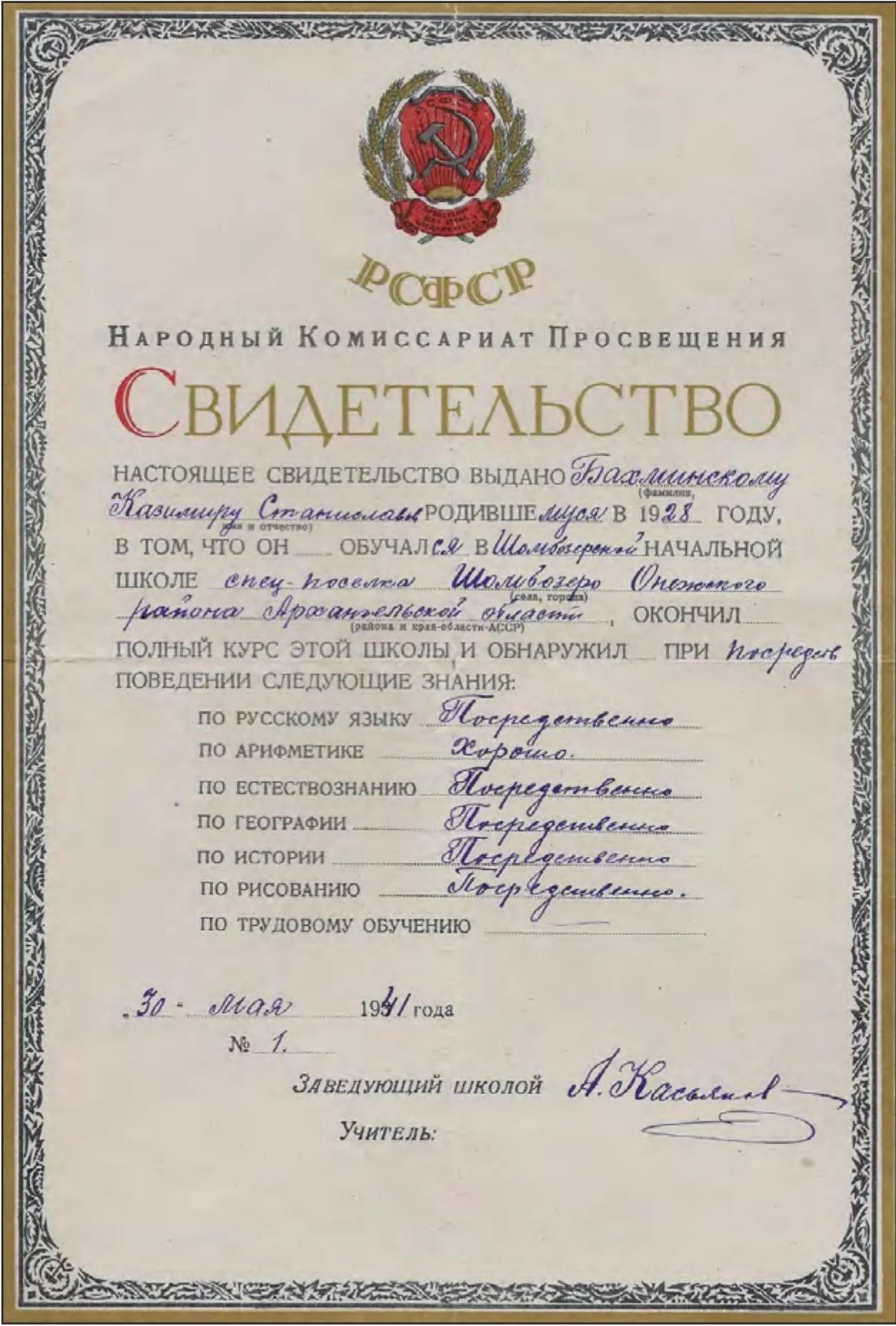
– Zdravstvuyte, malchiki! Chto vy zdes' delayete? (Good morning, boys! What are you doing here?)
– Terebim golyo (We're clearing branches), we replied.
– Vot khorosho (That's good), Kasyanov replied, and added: – Odnako vy dolzhny yekhat' v Onegu, uchit'sya dal'she v shkole, okonchit' sem' klassov, i togda vy budete kvalifitsirovannymi rabochimi (But you ought to go to Onega to continue at school and complete seven years, and then you will be skilled workers).
We parted from our teacher on friendly terms, but his wish for our future careers as skilled workers in the taiga did not come true. On 22 June 1941 Germany attacked Soviet Russia, and soon the spetspereselentsy became free people, and my brother and I lost our chance of becoming skilled lesoruby (lumberjacks).
When we were deported on 10 February 1940, Father, who was employed as a forester in Wołkowysk, had not yet received his salary for January 1940. Once at the settlement, Father immediately wrote to his employer in Wołkowysk demanding payment. Unfortunately the money did not come, so Father wrote a complaint to the District NKVD Commandant's Office in Onega asking for its intervention. The intervention was successful, and a notice came from the post office in Karamino that 808 roubles had arrived. Going to the post office in Karamino, 20 km away, required a pass from the commandant to leave the settlement. The commandant issued a pass that read: “This pass has been issued to special resettler of Special Settlement no. 68, Bachmiński Stanisław. He is permitted to go to the post office in Karamino. Valid until 24.11.1940.” It was stamped with a triangular stamp bearing the words Delegation No. 68 in the middle and, around the edge: NKVD USSR, Arkhangelsk Administration.
The money sent from Wołkowysk was very precious to us. It was the salary for January and nine days of February 1940. A forester's salary was 600 roubles a month, while here a forest labourer could earn 100 to 150 roubles, which shows the scale of the degradation. The money was very welcome, because from November 1940 Father was no longer earning, being constantly on sick leave; his health was steadily deteriorating, and in winter the frostbite in his toe returned. His health was so bad that on 12 August 1941 the Vrachebnaya Komissiya, the Medical Board, convened as required at Szomboziero and consisting of a chairman and a medical assistant, issued a decision (a photograph of the surviving document is below) that Bachmiński Stanisław Ivanovich, aged 49, suffered from a heart condition, was unfit for work and was classified in the second invalidity group. Soon after, in the last ten days of August, he was in hospital at Chekuyevo with symptoms of hunger oedema, although the medical assistant described the illness in the hospital certificate as chronic myocarditis. They described all these hunger-related illnesses as heart defects, porok serdtsa, or myocarditis. Unfortunately his stay in hospital lasted only ten days, and Father was discharged but not cured. The reason for his premature discharge was the authorities' decision to empty the hospital and keep beds in reserve for soldiers wounded at the front. It was already the third month of the war between the Soviets and Germany, and hospital beds far behind the lines were urgently needed.
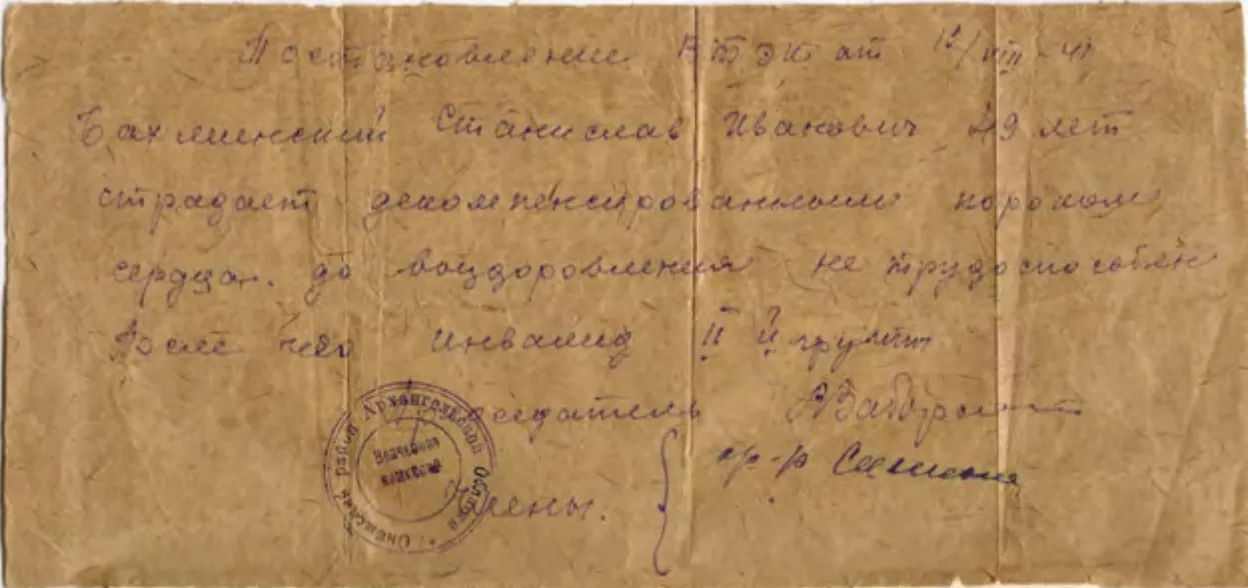
Notes
- Ed. Ewa Rybarska, Deportowani w obwodzie archangielskim. Część 1. Alfabetyczny wykaz 9320 obywateli polskich wywiezionych w roku 1940 z obwodu białostockiego, Warsaw 2003, p. 65. ↩
- Deportacje obywateli polskich z Zachodniej Ukrainy i Zachodniej Białorusi w 1940 roku, Warsaw/Moscow 2003, p. 289. ↩
- Ed. Ewa Rybarska, Deportowani w obwodzie archangielskim. Część 1, Warsaw 2003, p. 41. ↩
- Ed. Ewa Rybarska, Deportowani w obwodzie archangielskim. Część 1, Warsaw 2003, p. 359. ↩
- Chmielewski survived the labour camp and after the amnesty, with the last of his strength, reached Uzbekistan, where he was reunited with his family. Walerian Wysocki writes about this in his Wspomnienia z 1940–1944. W tajdze i na stepie. ↩
- Ed. Ewa Rybarska, Deportowani w obwodzie archangielskim. Część 1, Warsaw 2003, p. 71. ↩
- Ed. Ewa Rybarska, Deportowani w obwodzie archangielskim. Część 1, Warsaw 2003, pp. 103–739. ↩
- Ed. Ewa Rybarska, Deportowani w obwodzie archangielskim. Część 1, Warsaw 2003, p. 370. ↩