- Introduction
- Chapter I: My Family and My Town
- Chapter II: Deportation
- Chapter III: Amnesty
- Chapter IV: The Journey to Kazakhstan
- Chapter V: In Dzhambul
- Chapter VI: In Iran
- Epilogue
Chapter V
In Dzhambul
Dzhambul (Taraz), 1942
Seeing the hopeless situation we were in, Mother decided that we must move to Dzhambul (Taraz) at once. To do so, she went to the town to look for lodgings. She found cheap lodgings in a private house on the outskirts of the south-eastern district of Dzhambul, on Molokanovka Street. She had no trouble arranging with the kolkhoz chairman the formalities for our leaving the aul, hired a cart, and we moved to our new home. This was in the last days of December 1941. Our stay in the kolkhoz had lasted one month, and it must be said that it was the hardest and worst month since the deportation. Molokanovka Street was unpaved, a dirt road that turned to mud in the rain, lined with small single-storey wooden houses. The house where we were to live consisted of one room, a kitchen and a spacious entrance hall through which one entered the kitchen. The four of us lived in the kitchen, while our landlady, the owner of the house, stayed with her children in her room and also used the kitchen when she wanted to cook. At night we spread our bedding on the kitchen floor, although there was not much free space there. Our landlady, our khozyayka, was a Russian with three boys aged three, six and ten. Her husband had recently been called up and was in the nearby town of Lugovoye for military training, after which he was to go to the front. We had to pay rent for our modest lodgings, but I do not remember how much; I think it was not much.
Our life on Molokanovka was incomparably better than during the seven weeks spent in the wagon or the last month in the kolkhoz. What was very important was that here we received bread ration cards for the whole family. The cards were issued by the ULKOM, the committee managing the affairs of the street's residents. It was a one-person committee, with whom our landlady was on friendly terms, as shown by the double bread cards she received for her family.
Our landlady was about thirty, a slim, pretty woman who played the guitar beautifully and sang nicely. She began teaching me to play the balalaika, a three-stringed Russian instrument somewhat like a mandolin. I learnt to play several tunes on the balalaika quite well. All the while our landlady was waiting for the train in which her husband, having finished his military training, would pass through Dzhambul on his way to the front. Besides her, many women in Dzhambul were preparing to meet their husbands on their way to the front, but the date of this meeting (vstrecha) kept being put off. At last word came that the troops were already travelling towards Dzhambul. The meeting and farewell took place, and our landlady came home at peace.
We got on well with our landlady's boys. At night I wore a nightshirt to bed, as was the Polish custom, but the Russian boys were always surprised that I slept without trousers (on bez shtanov spit). The boys, as was the Russian custom, went to bed in their trousers, the same trousers they wore by day. The youngest, three-year-old Kolya, had a very big belly and went about the house with no trousers at all, his belly on show; it must surely have swollen from poor nourishment. Living in the kitchen had the advantage for us that it was quite warm there. As soon as our landlady had said goodbye to her husband on his way to the front, she began holding frequent drinking parties in her room. Several people would gather there; they drank spirit diluted with water, which was very cheap here, and she played the guitar and sang merry songs. I remember one of these songs; it went like this:
| Russian | English |
|---|---|
| Dengi, dengi, dengi | Money, money, money |
| Syuda denyushki, druz'ya | Give me some money, friends |
| A bez deneg zhizn' plokhaya | Without money life is poor |
| Ne goditsya nikuda. | And it's no good at all. |
| Pudry, pudry, kraski | Powder, powder, paint |
| Syuda pudry bez kontsa | Give me powder without end |
| A bez pudry kak lakhudry | Without powder you're a slattern |
| Ne godish'sya nikuda. | And you're no good at all. |
The money we had got for the things sold in the kolkhoz began to run out, and we were short of cash to buy food. Evidently our diet was very poor, because Mother fell ill again: she showed symptoms of hunger oedema, the same as she had had at Katiszcze. We young ones somehow coped better with the lack of vitamins and protein, because the swelling did not attack us. The only sign of malnutrition I noticed in myself was unhealing sores on my body where I had cut or scratched myself. This vitamin deficiency of mine had appeared earlier, during our time in the Arkhangelsk Oblast. For a long time, too, I could not get rid of the effects of a frostbitten ear I had suffered in the winter of 1940/1941. Since Mother was unwell, which showed not only in swollen legs but also in loss of strength, my brother and I had to take charge of selling things at the market. My problem, however, was that my shoes had completely fallen apart and I had nothing to put on my feet. Fortunately spring came quickly, and by mid-March I could walk to town barefoot. My brother and I went to the market, where we spread out a sheet and laid on it the things for sale. They were not valuable things, so the money we got for them was not much. Food supplies at the market were fairly good: one could buy vegetables and fruit, and also kishmish, or raisins. Of the meat on offer, mutton predominated, because the Kazakhs bred sheep on the kolkhozes. Their rams and ewes had no tails, only large fatty rumps hanging down.
Mother's health worsened and we did not know what to do. It would surely have gone very badly had someone not appeared to help Mother and all of us. This was Mr Józef Korzeniowski, whom I met by chance in the town. Mr Korzeniowski was living in Dzhambul with his wife and daughter, and with him, in a couple of rented houses, lived a larger group of Poles, including three families from Szomboziero: the Rozwadowskis, the Labochas and Mrs Wróblewska with her children. They had travelled with us in the same transport, only in a different wagon, from Karshi to Kazakhstan, and had managed to get off at Dzhambul, so they did not end up in a kolkhoz as we did. When I met Mr Korzeniowski I told him about Father's death and Mother's illness. He decided at once to come with me to our lodgings to see how things stood. First of all he helped us financially, giving Mother five hundred roubles and taking in exchange a kilim of roughly the same value, which he intended to sell at the market. He told us to buy as much food as we could and feed Mother well. Mr Józef also gave me his address, 2 Karasu Street, and invited me to visit him. The money was indeed badly needed, because with it we could buy plenty of nourishing food, and Mother's swelling soon began to go down. Among these purchases we once bought a live rabbit, which was kept in the entrance hall for a few days, and there was the question of who would know how to kill it. I remembered something about a rabbit supposedly being easy to kill with a blow of two fingers between the ears. I tried to kill it that way, but the rabbit did not react to my blow between the ears. It had to be finished off with a thick log instead of two fingers.
Having Mr Korzeniowski's address, I decided to go to Karasu Street to visit him. He lived with his wife and daughter, together with the Labocha family, in a small one-room house of the Kazakh kibitka type. Next door was a second, larger house rented by Poles, among whom I found Mrs Jadwiga Wróblewska with her daughter and son and Mr Rozwadowski with his wife and daughter. There were also three more families: Mrs Jezierska with two small children, whose husband had owned an agricultural machinery repair workshop in Wołkowysk; Mrs Stasia Szczawińska with her mother and her son Jurek; and Mr Mickiewicz, a railway engine driver, with his wife. Mrs Jezierska and Mrs Szczawińska were well off, because they had spent a year and four months less in exile than our group from Szomboziero and so still had plenty of things to sell. Altogether twenty people lived in the two houses, twelve of whom had come from Szomboziero and Katiszcze, so it was quite a sizeable Polish colony. When I got home I told Mother how the Poles in this colony lived, and the idea quickly arose that we should live there too. Soon Mother went to Karasu Street, where she met Jadzia Wróblewska, with whom she had been friends since Katiszcze, and it was quickly decided that we would share a room with Mrs Jadzia. The move soon took place. We said goodbye to our landlady, with whom we had lived for more than four months, from January to the beginning of May, and settled in our new home. In our room Mrs Jadzia slept with her two children in one bed, and we took the other bed, where Mother, Zbyszek and Hania slept, while at night I spread a cotton rug on the floor and covered myself with a sheepskin coat. Fortunately our room had a wooden floor, unlike the kolkhoz!
Our new home was near the goods station, which was a very handy location, because there were heaps of coal at the station, and we needed coal for heating and cooking. My brother Zbyszek and I soon became the coal suppliers for some of the occupants of our house. It must be admitted, though, that Mrs Jadzia tried stealing coal on her own account, and a few times she succeeded. On one such expedition she took my Mother along for company, and when they reached the coal heap a watchman appeared. The watchman tried to grab Mrs Jadzia, but she pushed him and he fell. Both of them started to run, Mrs Jadzia, younger and fitter, in front, while my Mother, weaker in the legs, fell behind and was caught by the watchman. The watchman called the militia, and the militia put Mother in the cells. Our men tried to get her out. She was indeed facing a prison sentence for stealing public property. A representative of the Delegation of the Polish Embassy, which had its office in Dzhambul, took up the matter of her release, and his intervention proved successful: after a few days Mother was released.
Besides coal, another valuable fuel was saxaul, a desert and steppe shrub. Our Polish colony was near the airfield, where large stacks of saxaul were piled. One of the men suggested going to the airfield one evening for saxaul. My brother and I were co-opted into the party of three men organising the expedition. We had not stolen much saxaul when a watchman appeared, and then someone more important from the airfield guard, and we were taken to an office and told to wait for the militia. But our resourceful men settled the matter amicably by handing the guards what was probably a small sum, and thanks to that everything ended happily.
While living in our Polish colony I often went into town alone or with my brother, mostly to the market square to sell what was left of our belongings. One day I went to the market to sell something; I spread a small blanket on the ground and laid out a few odds and ends on it, among them one fairly valuable item: a shirt of Father's. At a certain moment I noticed that the precious shirt had disappeared; someone must have stolen it. Without much thought I rolled up my blanket with the goods, tied it in a bundle and began walking round the market looking for my shirt. Suddenly I noticed a tall young man standing in the square holding out a shirt for sale. I realised at once that he was wearing my shirt, which he had stolen, and was selling his own rather wretched one, which he had taken off. I went straight up to him and began shouting: “Otday moyu rubashku!” (Give me back my shirt!). He told me to clear off and began threatening to beat me, and even raised his fist, but by then a sizeable crowd had gathered round us in a circle, and everyone was on my side: they believed he had stolen my shirt. A moment later a militiaman appeared and made the thief give back what he had stolen. Another time, on my way into town, I ran into a Kazakh boy, bigger than me, who blocked my way and clearly wanted to fight me, because something about my behaviour did not please him. There was no way out; a fight ensued and went on for a very long time. There was no winner: both of us bloodied and with torn shirts, we broke off the fight from exhaustion.
Dzhambul was a large oblast capital, and there was a larger concentration of Poles living in the kolkhozes in its region, while in the town itself a Delegation of the Embassy of the Republic of Poland was set up, whose task was to help Poles who came to it and also to take part in directing men to the recruiting points of the Polish Army then being formed. The military agreement that provided the basis for forming a Polish Army on Soviet territory was signed on 14 August 1941. The command of the army being formed was placed at Buzuluk, a town between the middle Volga and the southern Urals, and three infantry divisions were organised there. At the beginning of 1942 the headquarters of the Polish Army moved to Yangiyul, a town in Uzbekistan 30 km south of Tashkent, the capital of Uzbekistan. With the influx of large numbers of Poles released from labour camps and special settlements, and of soldiers who had been taken prisoner by the Soviets in 1939, further divisions and other units were organised, and at the same time the first three divisions were moved from the Buzuluk area south to Uzbekistan and Kyrgyzstan. The army also accepted young people aged 14 to 18, for whom junak (cadet) units were formed. Three thousand young people were accepted into the junaks. The commander of the Polish Army was General Władysław Anders, who worked to have the Army withdrawn from the Soviet Union. He obtained Stalin's consent to evacuate part of the units already formed (the 8th, 9th and 10th Infantry Divisions) to Iran. The evacuation took place at the turn of March and April 1942 and covered 33,000 soldiers and 11,000 civilians, 44,000 people in all.
Although we lived in Dzhambul, where the Embassy Delegation had its office, and among well-informed Poles, we knew very little about the Polish army being formed. Mother often went to the Delegation, from which she received a little help in the form of blankets, but her main aim was to get the Delegation to take her children into its care, since our material resources were exhausted and there was nothing left to sell. The Delegation decided that my brother and I would go to where a Polish division was stationed, where the army would probably take care of us and we would be accepted into a junak unit. On the appointed day we boarded a train with a representative of the Delegation and set off westwards, though our guardian did not tell us where we were going. After a few hours we reached a station called Chok Pak, where the Polish division was supposed to be stationed. We got off at this small station among high mountain slopes, but unfortunately the Polish army units were no longer at Chok Pak. Only a dozen or so soldiers remained, clearing up after the 8th Infantry Division, which had been evacuated to Iran at the turn of March and April. That a Polish division had been stationed at Chok Pak was shown by a sizeable cemetery, a forest of crosses telling that not everyone accepted into the army had survived. These exiles usually arrived in rags, starved and exhausted, and easily fell victim to the infectious diseases spreading through the units, such as typhus and dysentery. Since there was nobody at Chok Pak to take us in, we had to go back, and our trip there, somewhat “blind”, showed that our Delegation did not know that the division stationed only a hundred kilometres from Dzhambul had been withdrawn. Though it is possible that the Delegation did know and was trying to force us onto the small group of soldiers who had stayed behind at Chok Pak. To get into the junaks on our own we would have had to travel all the way to Uzbekistan, where further recruitment into the army and the junaks was taking place, but that was not considered, because of the great distance separating us from the Tashkent area and the high risk of setting off into the unknown and the family being split up.
The summer of 1942 in Dzhambul was scorching. Leaving the house I had a view of the nearby goods station, which was busy and noisy with shunting trains. Looking the other way, to the south, I saw a mighty mountain range with snow-capped peaks four thousand metres high. These were the Tien Shan Mountains, and the snowy peaks were fifty kilometres from Dzhambul, although they seemed very close. The advantage of our new home on Karasu Street was that a stream of very clear water flowed close by, and in that scorching summer it was a splendid place to bathe. Zbyszek and I bathed endlessly, swimming and diving headfirst from the high bank.
At that time soldiers of the Polish Army began to appear in the town. They were soldiers looking for their families or liaison officers searching for soldiers' families and organising their departure as part of the planned evacuation to Iran. Army headquarters was in Uzbekistan, in the town of Yangiyul. Thanks to British support and General Anders's efforts, on 8 July 1942 Stalin agreed to the evacuation of the entire Polish army to Iran. In this second stage of the evacuation General Anders also intended to take with the army as many civilians as possible. So soldiers were sent to the larger concentrations of Poles in Kazakhstan and Uzbekistan to look for their families and for other people eligible to leave. For some reason, news about the possibility of leaving did not reach us in Dzhambul, and the Delegation showed no initiative in the matter either. One day in town, near the Delegation, Mrs Jadzia met a Polish soldier and got talking to him, and the soldier told her proudly that he had just found his wife and children in a kolkhoz 10 km from Dzhambul and that his family would soon leave for an evacuation point in Uzbekistan, from where it was possible to go on to Iran. Mrs Jadzia told him about her difficult situation, alone with two children and without means, and asked for help so that she too could go to an evacuation point. Mr Nadański, for that was the soldier's name, promised that he would come back to Dzhambul in a week and bring tickets for Mrs Jadzia and her children to travel to Shahrisabz in Uzbekistan, where his 6th Infantry Division was stationed. Sure enough, a week later he came and brought a document authorising the purchase of nine tickets: three for Mrs Jadzia and six extra ones at her disposal. Mrs Jadzia gave the extra tickets to Mrs Szczawińska and Mrs Jezierska, who lived in the next room. Unfortunately there were no tickets left for the Bachmińskis. My Mother would not leave Mr Nadański alone, arguing that she was in a hopeless financial situation and moreover deserved to leave as the wife of a distinguished legionary decorated with the Cross of Independence. She showed her husband's documents concerning his service in the Legions. Mr Nadański promised to arrange tickets for us too and said someone from his unit would soon bring them.
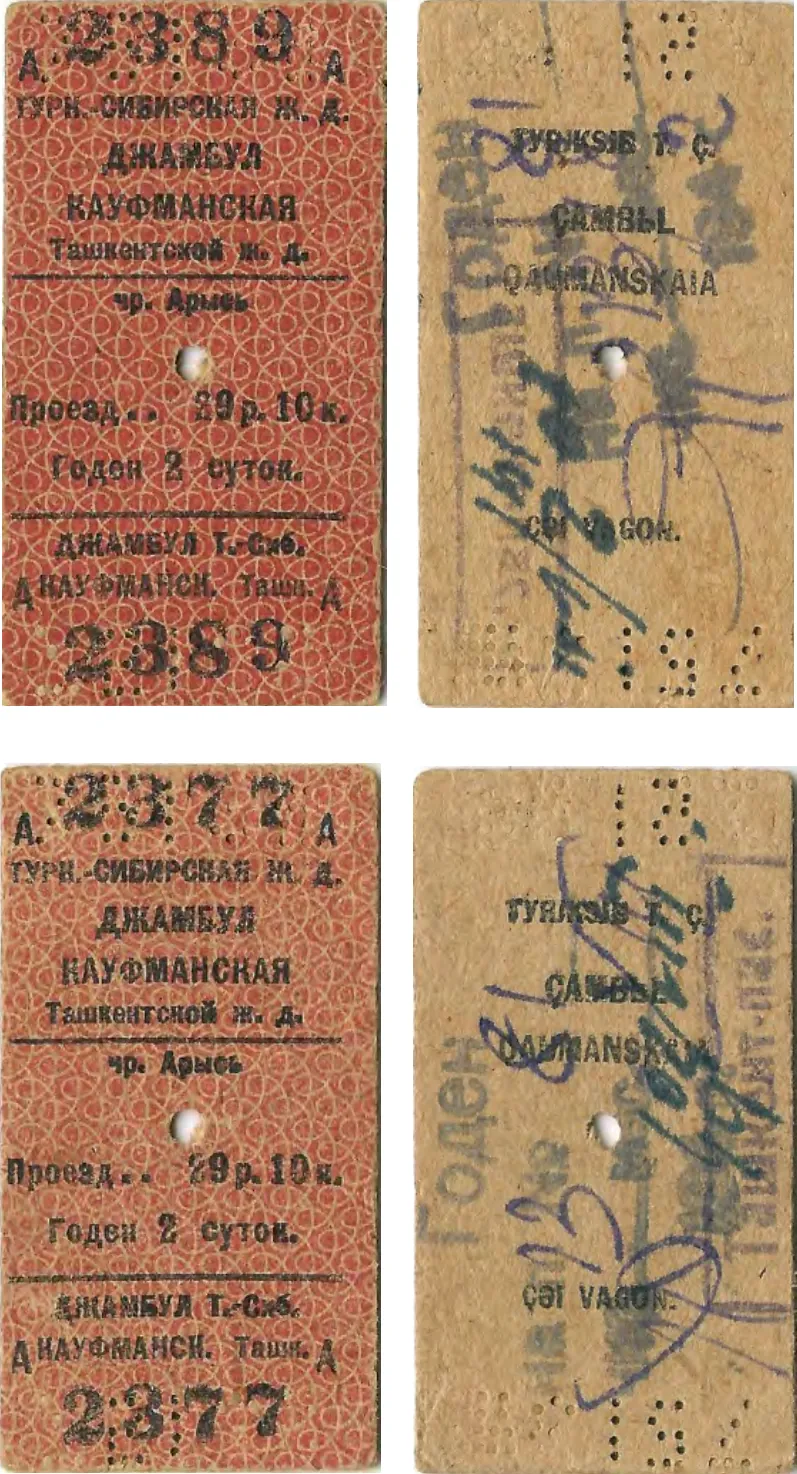
Within a few days Mrs Jadzia and Mrs Szczawińska and Mrs Jezierska left; this was some time in mid-July 1942, and we were left waiting to see whether anyone would come with tickets for us. But luck was on our side! Around 10 August a liaison soldier came to us and brought from army headquarters a document entitling us to buy railway tickets at the station, from Dzhambul to Yangiyul, for the number of people it specified. At that time one could not travel in the USSR without the authorities' permission, so to leave Dzhambul we needed confirmation from the Polish authorities that our journey by rail was justified. According to this requisition there were to be enough tickets for all the occupants of our house, but in fact it turned out that two tickets were missing. For everyone to be able to leave, someone had to travel without a ticket, as a stowaway. It fell to the youngest, my eight-year-old sister and me: we were to be smuggled on board without tickets. We left on the afternoon of 13 August. When the conductor checked tickets, my sister was hidden under the bench on which Mother and Zbyszek were sitting, while I, the second passenger without a ticket, hid somewhere, and the conductor did not catch me once during the journey. The two tickets, priced at 29 roubles 10 kopecks each, on which the four of us travelled, I have kept as the only material souvenir of that period.
Yangiyul was about 350 km away and our journey did not take very long. It was the site of one of the evacuation points from which Poles left by train for the port of Krasnovodsk (Türkmenbaşy), and from there went on by ship across the Caspian Sea to Iran. When we got off the train at Yangiyul we easily found our way to the registration point for Polish citizens due for evacuation. After registering we went to our quarters, where we were to wait our turn. Our quarters were a nearby park, where we took a place under a tree beside the other people gathered there. Fortunately August 1942 was warm and fine, it did not rain, so we spent several days and nights in that park without complaint. We slept on a sheet spread on the ground. Yangiyul was a town of several tens of thousands of inhabitants, mainly Uzbeks, on the Chirchiq River, which flowed through the area occupied by the Polish units and the civilians waiting to leave. We waited patiently for a whole week, and having plenty of free time and free food we often went into town (of course one person had to stay with our belongings), where in the bazaar one could buy various southern fruits such as peaches, watermelons and melons. The draught animals in the town were donkeys and camels. Near where we were camped there was also a Polish bazaar, where soldiers sold their food rations and other things. One day I bought from such a Polish soldier two metal tins of chocolate, of the kind that in the British army formed the “emergency” ration, eaten when a soldier at the front is facing starvation. The price was exceptionally low, so I bought two tins without checking what the chocolate looked like. A moment later, when the soldier had disappeared, I opened one tin and found only half a bar of chocolate inside. I checked the second tin, and it contained clay. Oh well, I had been taken in.
Our stay in Yangiyul came happily to an end. A long passenger train was brought to the station to take us to Krasnovodsk. A whole week of camping in the open was over, and now a journey lay ahead of us towards the Caspian Sea, 1,800 kilometres away. We travelled via Samarkand and Bukhara and then entered the territory of Turkmenia, a desert country, where for many hundreds of kilometres the train ran along the edge of the Karakum Desert and nothing but sand could be seen from the train to the horizon. We passed the capital of Turkmenia, Ashgabat, and after many more hours we found ourselves near the Caspian Sea. The train stopped a few kilometres from Krasnovodsk, the port from which we were to sail to Iran, and we were ordered to get off straight onto the desert sand. There was no station or platform, only an ordinary railway embankment running across the desert. It turned out that we were to wait on the sand until word came that a ship was in port for us. We camped on the sand for two days and nights, I think, and the worst thing was that there was no drinking water, while by day the sun blazed mercilessly. Local Turkmens went round selling water at astronomical prices. Soviet customs officials also appeared, demanding that we hand over our roubles, which could not be taken abroad, and claiming at the same time that nothing could be bought with roubles in Iran. A few Poles handed over their roubles, afraid that they would be searched when boarding the ship and that their departure might be put in doubt. The sea was a few hundred metres from where we were camped, and I decided to go bathing. My first swim was rather symbolic: I went into the water in my short pre-war trousers, which were full of holes, and after swimming in the sea and coming ashore I put on the new shorts I had been issued before leaving Yangiyul.
At last our ordeal on the sand and in the heat came to an end. The order came that we were to go to the port of Krasnovodsk, because a ship had docked. The march was very hard, because we had to carry all our belongings on our backs and in our hands in one go. We reached the port worn out by the heat and the carrying. A cargo ship of no great size was moored there; we went aboard up a gangway and were then directed down a staircase into a large cargo hold. So many people ended up in that hold that arms, legs and other parts of bodies were tangled together and people lay on top of one another. One could get used to the crush, and everything was more or less bearable until the ship put out to the open sea. Then it began to roll heavily and people started vomiting. The upper deck was occupied by the army and was so crowded that walking on it was almost impossible. There was a toilet somewhere up on the upper deck, but it could not serve so many passengers, and getting to it required the skills of an acrobat. The port in Iran was five hundred kilometres away, and our voyage across the sea in these difficult conditions lasted two days and nights.